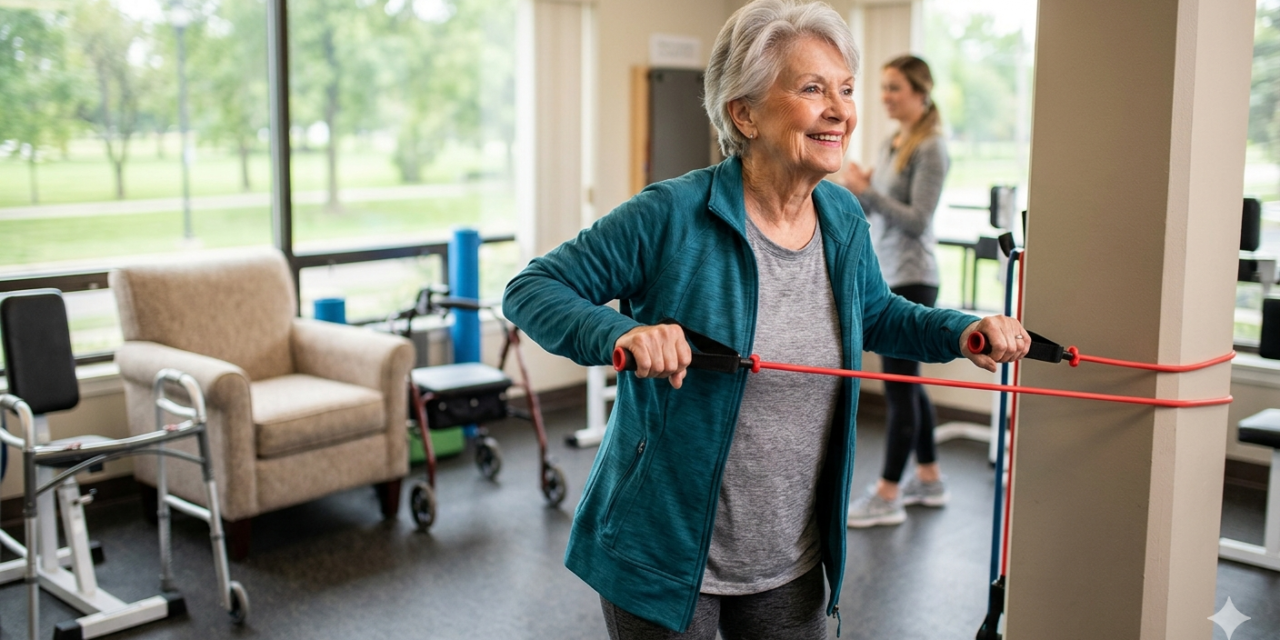
Because of our specialty in chronic conditions and seniors, we get lots of clients who are frail. But “frail” is not the same thing as merely “out of shape.” A person can be out of shape, yet still have the necessary strength, endurance and mobility to complete their activities of daily living (like wash themselves, drive, walk, go up/down stairs, etc). By definition, a frail person can’t do any of those things (at least not without great difficulty). This article is about the latter person.
Here, we’ll discuss:
- Who benefits the most from exercise
- The frail person’s psychology
- Why frail people need more exercise than fit people
- How much strength training do frail people need?
If you want help with your own, or a loved one’s frailty, we have a special program, called “Frail to Fit.” To see whether that program is for you, just fill out the application form on our home page. Doing so doesn’t obligate you to anything. It’ll just set up a quick, 10-15-minute chat about your current situation, and whether we can help you. There’s no pressure, no obligation, and no sales pitch.
Who Benefits the Most from Exercise
When we think of exercise, we usually think of young, healthy people and athletes. And while exercise is indeed beneficial for them, it’s not necessarily life changing.
A person who already has 10% body fat, and gets down to 8% body fat – they look a bit better, but otherwise, nothing is different for them. They wear the same clothes, work the same job, etc.
A person who already has a 200-pound bench press and improves to 220 pounds – their life isn’t any different either. They still wear the same clothes, their activities of daily living were not a challenge before, and they’re still not a challenge. Basically, the only difference is in the gym. Nothing is different outside the gym.
A person who can already run a 5K, and improves to 10K – the same thing happens (or doesn’t). They’re just better at running. Their life isn’t substantially different. They had no problems with their activities of daily living when they could “just” run a 5K, and they have no problems with those activities now, either.
But a person who was so weak that they could only shuffle step, and they improve their strength and balance just enough to be able to walk without shuffling – their life is dramatically different. It opens up their possibilities tremendously. Things that we usually take for granted are not appreciated until we can’t do them anymore. When someone shuffle steps:
- Simple grocery shopping is difficult and very time-consuming
- Standing in your kitchen and cooking for an hour or two is very fatiguing, and maybe painful
- Going out with your spouse or friends feels like a chore instead of a pleasant activity
- They might need the help of a loved one, or a professional to take care of themselves
- If they shuffle step on flat ground, forget about going up and down stairs – that’s either completely off-limits, or a dangerous activity
These are the people who benefit the most from exercise. But notice that the frail person benefits when they simply go from very weak to average. Not from fit to super fit.
And yet, even though they benefit from exercise the most, they also engage in all kinds of self-sabotage, which we’ll discuss in the next section.
The Frail Person’s Psychology
I Don’t Have Energy
Frail people often complain of low energy levels. They feel tired. I lovingly tell them not to use their feelings as an accurate gauge of their physical ability. Because there’s only a very weak relationship between our energy levels and our strength levels. How we perform and how we feel often have very little to do with each other. You can feel great, and your performance sucks. Or you can feel great, and your performance is also great. You can feel crummy and have great performance, or you can feel crummy and have poor performance.
Basically, our own subjective sensations of our energy levels are a very weak gauge of our physical performance on any given day.
This is not just my own theory and observations. Plenty of research backs this up.
In one study, participants did 2 exercise sessions:
- One session was done after doing a cognitively-demanding task for 90 minutes. This task required sustained attention, working memory and rapid response inhibition. It was cognitively demanding, but physically sedentary.
- The second session had no cognitively-demanding task. But they just sat there for 90 minutes, in the same lab environment.
Both conditions then underwent a physical endurance test: cycling at a high intensity, until you want to stop.
Unsurprisingly, when the participants did a mentally-fatiguing task first, they wanted to stop sooner. But why? Were they physically exhausted sooner? Nope. Because when objective measurements of physical fatigue were taken (heart rate, lactic acid, oxygen consumption), they weren’t actually fatigued. They just wanted to stop sooner for no physiological reason.
In another study, 90 participants were divided into 3 groups:
- Group 1 did a mentally-demanding task
- Group 2 did a different mentally-demanding task
- Group 3 did not do any mentally demanding tasks
After that, all 90 participants did a test of their grip endurance. The two groups that did a mentally-demanding task first had worse endurance. But why? Did their muscles give up sooner? No. All the participants were measured with a device called an “EMG” (electromyography), which measures the electrical activity in a muscle.
The electrical activity in the muscles was the same between all 3 groups. So the muscles of the participants in the first two groups didn’t give out. Their will did. They had a lower willingness to sustain effort, and a higher perceived exertion. But actual exertion was the same as the well-rested group.
And just so you don’t think that I’m cherry-picking studies, while ignoring research that opposes my point of view, that’s not the case. One systematic review (which is a type of research study that aggregates many studies on the same topic) found the same thing: your energy levels have very little to do with your strength levels. A second systematic review found the same thing. The authors’ direct quote is “In sum, current evidence does not provide conclusive support for the claim that mental fatigue has a negative influence on exercise performance.”
So “part 1” to the argument of “I’m tired” is that in many frail people, the perceived inability to exercise is much greater than the actual physical limitation. The physical capacity for exercise is often far greater than they think.
Part 2 is that frail people often use the excuse of fatigue to not exercise. They wait until the fatigue goes away. But it never does. So they never exercise or use it as a reason to exercise less than they should.
It’s important to consider that exercise itself is a treatment for fatigue (assuming no deficiencies in iron, B12 or a slow thyroid).
Many of my frail clients start the session tired. By about mid-session, they have more energy. How is it that despite objectively spending energy, they have more energy? Because their mental fatigue went away.
I’m Going to Hurt Myself
This one is understandable. They already hurt, and they’re scared of either worsening their existing pain, or creating new pain.
As I talk about in my arthritis book, pain is both physical and mental. The reason that the brain creates pain is that it doesn’t feel safe. You know the best way to make the brain feel safe? Exercise. But not any kind of exercise, because if you do the wrong form of exercise, you will indeed increase your pain. Rather, graded, progressive exercise, in the pain-free range of motion.
Progressive exercise is resilience training. The threshold of what it takes for you to hurt rises, and your previous pains diminish in both intensity and frequency. We have literally dozens of case studies of clients in pain, who are no longer in pain, like:
- Ann, who went from painful post-surgery knee pain, to downhill skiing again
- Soo, who went from knee pain so bad, she had difficulty walking and climbing stairs, to doing split squats with 100 pounds, pain-free
- Carol, who had a knee replacement surgery scheduled, and cancelled it, because her knees no longer hurt, and others.
So yes, the fear of injury is legitimate, but with the right approach, you can get the benefits of exercise, and minimize the risks. Without turning this into a plug for my services, that’s why supervised, progressive exercise by someone experienced in long-term strength training for chronic conditions is often far superior to a DIY approach.
Physiotherapists can be extremely valuable for acute injuries and post-surgical rehab. But frailty reversal is usually not about short-term rehabilitation. It’s about months of progressive strength development, which is a different skill set entirely. Physiotherapists are good for acute injuries. Chronic conditions are not really where they shine.
I’m Frail, So I Need Less Exercise
First of all, when someone is frail, exercise shouldn’t be viewed as fitness. It should be viewed as treatment. When someone is in bad condition, they need aggressive treatment. That means more exercise, not less. As I argue in my article, Frail to Fit Fast, people who are frail need to exercise more frequently than fit people – not less frequently. Fit people are chasing new strength gains. Frail people are trying to regain lost strength. Big difference. The former requires a higher intensity with a lower frequency. The latter requires a lower intensity and a higher frequency.
When someone becomes frail, exercise shouldn’t be treated as optional fitness. It should be treated as targeted therapy.
Literally the only treatment for frailty is strength training. There aren’t any medications, supplements or diets that make a person stronger. Strength training is it.
On the surface, it makes sense why frail people think they need less exercise. They think that they can’t tolerate the same amount of physical work as someone fit. Here’s where I make the distinction. They can’t tolerate the same intensity (amount of weight lifted). But they can tolerate a much higher frequency and number of sets. Not only can they tolerate more, it’s actually beneficial to them.
Why?
Imagine a sedentary person, who’s never strength trained in their life. They have a lot of unrealized potential in terms of strength. As they get stronger and stronger, their ability improves, but their potential doesn’t. Let’s hypothetically say that a person’s potential is the ability to lift 100 pounds. But they’re sedentary, so they can only lift 40 pounds. As they get stronger, they can lift more and more weight, but their potential stays at 100 pounds. By the time they’ve doubled their strength, they’re now lifting 80% of their potential. They’re tapping into much more of their available resources. So each set they do is pretty taxing.
Frail people have similar potential as their peers of the same age, but an extremely low ability. They might have the potential to lift 100 pounds, but their ability might only be 20 pounds. Just to regain lost strength, they’d have to get up to maybe 40 pounds. But because they’re using such a small percentage of their potential, they can tolerate more sets.
In one study, researchers recruited 100 seniors in nursing homes. They specifically wanted frail seniors – not happy, healthy, fit seniors. These folks had an average age of 87 (some were in their 90s). These seniors were:
- Frail
- Having difficulties walking
- Needed walking aids (canes or walkers)
And the researchers had these folks doing high intensity strength training. Their protocol looked like this:
- 3 times per week
- 3 sets per exercise
- The weight lifted was 80% of their max
- The weights got progressively heavier as they got stronger. When someone can lift 10 pounds, 80% is 8 pounds. When someone can lift 20 pounds, 80% is now 16 pounds.
- The study only lasted 8 weeks.
At the end of the study:
- Their strength increased by 174%. That’s not a typo. A fit person can’t do that. Someone who can already bench press 200 pounds is never going to bench press 500. Even if a person who bench presses 200 pounds got up to 250, it would take several years. That’s what I mean by “regaining lost strength” as opposed to “building new strength.” The former happens very quickly. The latter, slowly.
- As a result of this significant and fast improvement in strength, the seniors in this study improved their walking speed, their ability to climb stairs, and those who needed substantial assistance became more independent.
See, frail people recover from exercise just fine for the very reason that they’re frail, so they can’t exert much energy. The energy they do exert is not significant enough to necessitate a long recovery period. Stronger people need more recovery. Weaker people need less.
Why Frail People Need More Exercise
One of the reasons that frail people need more exercise is the one we talked about in the previous section – they’re far away from their potential.
A second reason that they need more exercise is that because of their mobility impairments, they don’t accomplish the same amount of work in a certain period of time. For instance, someone without mobility impairments, can move from one exercise to the next without any delay. It might take them just a few seconds to move their feet to get from one exercise to the next, if it’s just a few meters away. A frail person might take 1-2 minutes to walk a few meters from one station to the next.
Because of that, an able-bodied person (even if they’re out of shape) might complete 3 sets of 7 exercises in a 1-hour session. A mobility-impaired person might only complete 2 sets of 5-6 exercises in the same 1-hour session. For them to do the same amount of work as an able-bodied person, they’d need to exercise for 1.5-2 hours (or, shorter sessions, more frequently). And they should, because when someone is frail, I want to repeat – they need aggressive treatment. That treatment is strength training.
When a person has a serious medical diagnosis (like cancer, etc.), they drop everything, and devote extra time and energy to that diagnosis. The priority of that really rises. If there’s a conflict between hanging out with friends, and going to the doctor’s office, the doctor’s office wins. If there’s a conflict between family obligations and going to the doctor’s office, the doctor’s office wins. While frailty is not as serious as cancer, it certainly is a big impediment to their life. Strength training is at that point not vanity or a hobby. It’s simply regaining normal function – and it should be prioritized as such.
Case in point – Ruth Bader Ginsburg, one of America’s highest profile judges, had multiple cancer diagnoses. Her first one was in 1999 (colon cancer). After her battle with that, she started to prioritize exercise above everything else. If there was ever a conflict between her exercise routine, and a court case, she’d organize her schedule around her exercise routine, and not her court cases.
And despite multiple cancer diagnoses after the first one, throughout all her treatments, she continued exercising.
How Much Strength Training do Frail People Need?
In our earlier study, we saw that 3 sets per exercise, 3 times per week was not just well-tolerated, but really beneficial. In fact, that study showed more progress than every other study done since then.
This gives us a clue as to how much exercise frail people actually need. There are 2 ways to go about it:
- If they can tolerate high-intensity work, close to muscular failure, about 9-12 weekly sets per muscle group will cause pretty fast progress.
- If they can’t tolerate high-intensity work (they can’t come close to muscular failure), they’re better off doing more sets, at a lower intensity. So instead of 9-12 weekly sets, they might do 15-20 weekly sets per muscle group.
And when I say “can’t tolerate high-intensity work”, that’s not based on a subjective assessment of “I feel tired today. I can’t tolerate it.” No – frail people are notoriously conservative about their own abilities. They don’t believe they can exercise hard. Even though many of them can (but only hard, relative to their own abilities). Tolerance for high intensity work should be based on objective performance, not subjective feelings. Most frail people should not be evaluating their own tolerance because:
- They don’t have a background in exercise science.
- Their ability to self-evaluate isn’t accurate.
Also, keep in mind that this kind of relatively aggressive routine doesn’t need to be maintained forever. It only needs to be maintained until a person is no longer frail (which might take 2-9 months). Then, they can back off a bit. This is similar to treating other serious conditions, where in the initial stages, treatment is very aggressive, and as a patient gets healthier, treatment becomes less aggressive.
Frailty is not necessarily a serious condition, but in my opinion, it should be considered as such, because the gap between frailty and death is not large.
In the medical literature, frailty is defined as:
- Unintentional weight loss (10+ pounds over the previous year), or being underweight to begin with.
- Self-reported exhaustion
- Low grip strength
- Slow walking speed
- Low physical activity
If someone has 1-2 of these, they’re considered mildly frail. If someone has 3 of these, they’re considered moderately frail. And if someone has 4-5 of these, they’re considered very frail.
One landmark study of 5,317 people found that over 50% of people with severe frailty died within 3-4 years. This is compared to only about 12% of people of the same age, who weren’t frail. Furthermore, it’s not like those last 3-4 years are filled with great experiences, like hiking, playing golf and tennis, and vacationing. For frail people, these last 3-4 years are riddled with doctors’ visits, progressively worsening function, progressively greater dependence on caregivers (sometimes, those caregivers are professionals, and other times, family members), etc.
Fortunately, it’s not irreversible. Reversal is actually quite simple (but not easy): safe, progressive strength training, at the right “dosage” (amount of weight and sets per week).
If someone is frail, all their resources should be diverted towards reversing frailty (which, again, is highly reversible). If someone is knocking on death’s door, this is not the time to save money. In general, it’s wise to save your money. But the goal isn’t to die with as much money as possible, so that you can bury all of it in your casket. The goal is to use your money to enjoy and possibly, extend your life.
If you need help with your own, or a loved one’s frailty, we have a special program, called “Frail to Fit.” To see whether that program is for you, just fill out the application form on our home page. Doing so doesn’t obligate you to anything. It’ll just set up a quick, 10-15-minute chat about your current situation, and whether we can help you. There’s no pressure, no obligation, and no sales pitch.