Meet Sue. She used to be a stay-at-home mom (when her kids were small), and now, a grandma of 19 grandkids. She lives in Oregon. About a year ago, she was diagnosed with really severe osteoporosis in her lumbar spine (lower back). Fast forward to now, one year later, and it’s significantly better.
How did she do it? That’s exactly what we’ll cover in this case study. Here’s what you can expect to learn:
- What Sue’s life was like before the diagnosis
- Sue’s exercise program
- Sue’s nutrition and supplementation programs
- The results (how her T-Scores changed)
- Sue’s obstacles
- How her life is different now that her bones are significantly stronger.
If you’d like to hear Sue tell her own story, you can check out this 6-minute video:
And if you’d like some help with your own osteoporosis/osteopenia, we have a special program called the “Osteoporosis Reversal Program.” To see whether you qualify for it, just respond to this email with the words “Osteoporosis Reversal Program” in the subject line. Doing so does not obligate you to anything. It simply sets up a short, 10-15-minute chat where we discuss your current situation, and see whether we can help. There’s no pressure or sales pitch.
Sue’s Life Before
Sue had always been active. She enjoyed hiking, riding her bike, and chasing her grandkids. So she wasn’t exactly sedentary. But over time, she broke more and more bones: her arm, both feet, and her wrist. Her doctor thought this wasn’t normal, sent her out for a DEXA scan (that’s what’s used to measure bone density), and the result was unsurprisingly osteoporosis.
It wasn’t bad in her femoral neck and total hip, but the spine was extremely concerning. Her T-Score was -4.1. If you’re reading this article, and you don’t have osteoporosis/osteopenia yourself, this probably doesn’t mean much, so let me explain. A T-Score is a comparison of your bone density to peak bone mass (someone around 25-30 years old). A T-Score of +1 means you have stronger bones than the average young adult. A T-Score of -1 means that you have moderately weaker bones than the average young adult. Osteoporosis is diagnosed at a T-Score of -2.5. So a T-score of -4.1 is very severe. The risk of fracturing a spinal vertebra is very high.
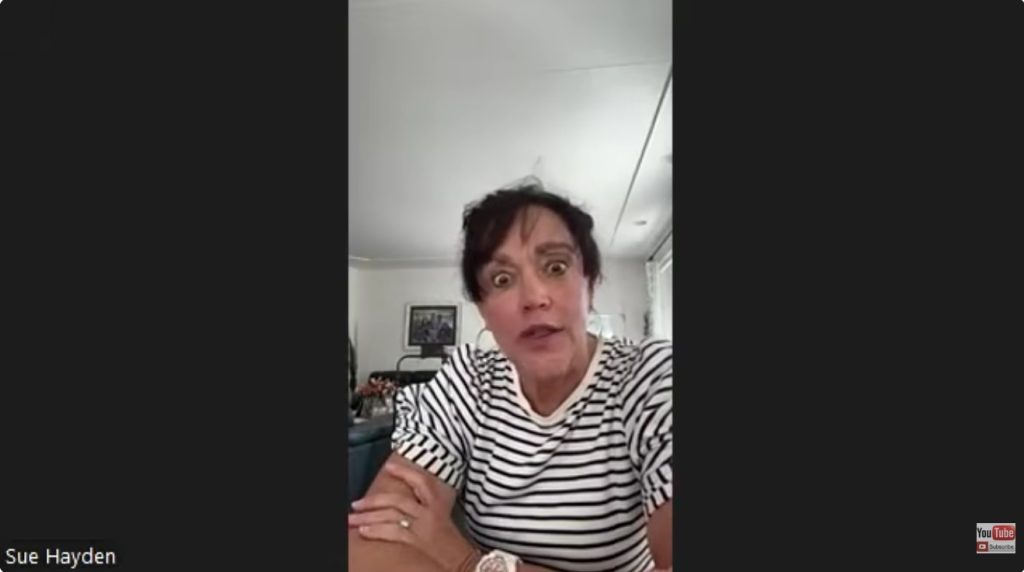
Sue Hayden
When Sue’s doctor saw that T-Score, she immediately recommended that Sue go on meds. Sue didn’t have a philosophical opposition to medications, so she went to the pharmacist to get the prescription filled. Before the pharmacist filled the prescription, he listed off the potential side effects. That scared Sue enough that she decided against filling that prescription. She thought there has to be another way.
That evening, she went on Amazon, searched for books about osteoporosis, and found mine. She read it, the approach resonated with her, but she wanted help implementing the advice. So she reached out to me, we spoke briefly, and I set her up with her personal trainer, Ashley.
Although before she reached out, she had one major hesitation: she wasn’t sure if it would work. But she decided to go for it anyway.
I just wanted to point out that Ashley lives in Saskatchewan and Sue lives in Oregon. Why did Sue choose to go with online personal training, as opposed to hiring a local, in-person personal trainer? The major reason: expertise. As I explained in several of my previous articles, it’s extremely difficult to find a personal trainer who understands osteoporosis. I’ve been in business since 2010, and in that time interviewed around 400 personal trainers. I always ask about osteoporosis. Out of those 400, the number of trainers who could answer questions about osteoporosis is probably around 5-6. And I’ve interviewed trainers all over the world – Toronto, New York, Los Angeles, London, Sydney, etc.
So Sue figured rather than interviewing a bunch of personal trainers in Oregon to find the 1.5% who actually understood osteoporosis, she’d hire virtually to access expertise she may simply not have access to locally.
Sue’s Exercise Program
Over the one year that Sue has been with us so far, she’s had a number of different programs, so I can’t go over every program in detail, but here are the highlights.
A basic principle of physiology is called “Wolff’s Law.” It states that bones only get stronger at the very spot where muscles pull on them with enough force. That’s why general exercise, while maybe good in general, doesn’t strengthen bones specifically. It’s not targeted, and the force isn’t high enough. Because of that, exercise selection is extremely important (and by extension, knowledge of anatomy).
So here are some of the exercises that Ashley had Sue doing:
- Banded Romanian deadlifts: These work the muscles of the hamstrings, glutes and lower back. Therefore, by extension, they work all 3 major skeletal sites: the lumbar spine, total hip and femoral neck.
- Banded squats: this one is particularly good for the T-scores of the femoral neck and total hip. This wasn’t her most severe area, but we didn’t want to neglect it, either.
- Dumbbell bent-over rows: While at first glance, this looks like an upper body exercise (and it is), it works the muscles of the biceps and lats (latissimus dorsi). The lats attach on to the lumbar spine, and therefore strengthen it.
- Dumbbell side bends: This one is targeting the T-scores of the lumbar spine, because it works both the obliques (sides of the abs), as well as the muscles running along the spine, called the “erector spinae.” Again, for bones to get stronger, you have to train the muscles that attach to those bones. General exercise (like walking, yoga, pilates, group fitness classes, etc.) isn’t good enough. Targeted exercise is what’s needed.
- Jumping on to a platform. When you jump the weight of the body above the lumbar spine puts positive pressure on to the lumbar spine, making it stronger. And yes, jumping is safe for osteoporosis, provided there aren’t any pre-existing fractures. Sue’s fractures have been healed by the point she started working with us.
These are just some of the highlights of Sue’s program. There were more exercises, and more programs.
Furthermore, if you just read about the exercises, you’d miss the “secret sauce” of the exercise program – the progression model, and the workout-by-workout adjustments that were made based on Sue’s progress from the previous series of workouts, energy/fatigue levels, and more. After all, no exercise program should be a static program, where you’re doing the same exercises for the same weights, sets and reps every single time. An exercise program should be dynamic, intelligently, purposefully, and systematically changing the exercise variables to move the client forward… as opposed to haphazardly changing the program whenever you feel like it, without rhyme or reason… like a lot of personal trainers do.
But exercise selection is only one piece of an exercise program. An exercise done with the right “dosage” (weight, sets, repetitions and tempo) will work. The right exercise, done at the wrong “dosage” won’t work. So let’s talk about the other elements of dosage:
Number of Reps
The number of repetitions you do and the amount of weight you use are inversely related. You can’t lift heavy weights for many reps. But the question is whether it’s just a matter of preference (lighter weights for many repetitions or heavier weights for fewer repetitions), or whether one is clearly superior to another. After all – both are difficult for different reasons, but is difficulty enough for effectiveness?
The research is very clear on this. In one study, researchers divided up participants (who were both men and women, 60-83 years old) into 3 groups:
Group 1: control group. They didn’t exercise
Group 2: low intensity strength training. They did 1 set of 13 reps at 50% of their maximum, 3 times per week, for 6 months.
Group 3: high intensity strength training (same exercises as group 2). They did 1 set of 8 reps at 80% of their maximum, 3 times per week for 6 months
At the end of 6 months, group 1 saw no changes. Group 2 improved their muscle strength, but not their bone density. Group 3 improved their bone density by almost 2%. What does this tell us? That light strength training is not enough to strengthen bones.
One large meta-analysis, that reviewed a bunch of studies found that strength training, using 2-3 sets of 8-12 reps, with 70-90% of your maximum, done about 3 times per week increases bone density.
The famous LIFTMOR study went even heavier – 5 sets of 5 reps.
See, bones don’t care about our preferences. Bones just respond to stimuli. We might prefer yoga or hiking over strength training. But that’s not the stimulus that makes bones stronger. The stimuli for bones are quite simple:
- Heavy weights or high resistance (relative to your own abilities).
- Progressive (getting heavier/more difficult over time).
- Targeted: training the muscles that attach to the bones with the lowest T-Scores (bone density).
Sue’s Nutrition and Supplements
First of all, if you’ve been a subscriber of my newsletter for any length of time, you already know my stance on calcium: it doesn’t work. I’ve written (it’s the first myth of the first chapter in my osteoporosis book) and talked about that extensively. Here’s a very detailed 15-minute video with my stance on calcium (both dietary and supplemental).
So calcium for osteoporosis is overrated. But protein for osteoporosis is seriously underrated. I first wrote about the importance of protein for osteoporosis in my book, in August 2022. Finally, by October 2023 a mainstream government body, Osteoporosis Canada, acknowledged the importance of protein for osteoporosis.
As I’ve mentioned in my other articles, I’ve never met someone who had osteoporosis and was also getting adequate protein. Most people with osteoporosis are unintentionally on a low-protein diet. Sue was no exception.
Ashley calculated Sue’s protein requirements, and after a dietary intake, figured out what was her actual intake. As expected, it was far below her requirements.
So together, they figured out simple strategies to increase Sue’s intake.
It’s good to have more than one way to improve bone density (exercise, nutrition, supplements).
As far as supplements that improve bone density, there are many that claim to do that, but very few with good human evidence that they actually do. Two of the most important ones are type I collagen (or specific collagen peptides) and soy isoflavones, for reasons that I discuss in my book.
Sue’s Results
Theory is nice, but in practice, how did all these strategies affect the bottom line – Sue’s T-Scores (bone density)? Her lumbar spine went from -4.1 to -3.6. That’s monumental!
But the most important thing isn’t even bone density. Rather, it’s fracture risk. Bone density is one component of fracture risk, but not the only component. I talk about the 5 components of fracture risk in this 6-minute video:
This kind of an improvement represents a large reduction in fracture risk (although it’s hard to put specific numbers to it), because unlike other interventions that only improve bone density, without improving muscular strength or balance, the approach Ashley used addresses all 5 components of fracture risk.
Besides the improvements in her bone density, she had seriously impressive improvements in her muscle strength as well. Sue used predominantly resistance bands, and here were the results:
- She wasn’t jumping at all. Now, she’s jumping off a 16-inch platform, and sticking the landing.
- She wasn’t squatting at all, and now squats, with 160 pounds of tension on the resistance band.
- Abdominals: she’s now adding 50 pounds of resistance to certain ab exercises.
Sue’s Obstacles
As impressive as Sue’s results are, they weren’t without obstacles. There certainly were obstacles along the way, like:
- Equipment availability: at first, all she had was dumbbells. A couple of months into her training with Ashley, she also bought resistance bands.
- She hurt her back getting out of a boat during the summer, and broke her wrist during one of her travels. She didn’t stop training. Ashley modified Sue’s routine.
- Her kids are spread out all over the country, so she flies frequently. Yet, that’s the benefit of online training – you can do it no matter where you are. She now got the reputation of “fit grandma”, so her grandkids now pick her up from the airport with a protein shake.
- She has one adult child with special needs, so that occupies her time.
…and yet, despite these obstacles, Sue has achieved very impressive results and has been a pleasure to work with.
How Sue’s Life is Different Now
How’s Sue’s life different now that her lower back is a lot stronger? Dramatically.
- First of all, when her doctor saw that she didn’t fill the prescription, she was very concerned. But when she saw Sue’s follow-up test, the doctor said that she wishes that all of her osteoporotic patients would do personal training.
- When she was recently diagnosed, she got a fear of movement. She was afraid of falling and breaking another bone. Nowadays, she still has osteoporosis in her lumbar spine, but it’s not as bad as it was a year earlier, and the surrounding muscles are much stronger. For one thing, she’s less likely to fall. For another, even if she was to fall, she’d be less likely to break a bone.
- She actually feels stronger, because well… she IS stronger. There’s a certain confidence that comes with going from average strength to stronger than you were decades earlier.
- She’s more active now. She hikes, cycles, obviously does strength training, and chases after her grandkids. She wanted to be able to get down on the ground, and get off the ground in order to play with them. Now she can.
- When she went to get her DEXA scan, the nurse told her that she doesn’t look 65.
Overall, it’s a pleasure working with someone as determined and compliant as Sue. It gives us a lot of pride in her. If you’d like to get results similar to Sue, we have a special program called the “Osteoporosis Reversal Program.” To see whether you qualify for it, just respond to this email with the words “Osteoporosis Reversal Program” in the subject line. Doing so does not obligate you to anything. It simply sets up a short, 10-15-minute chat where we discuss your current situation, and see whether we can help. There’s no pressure or sales pitch.