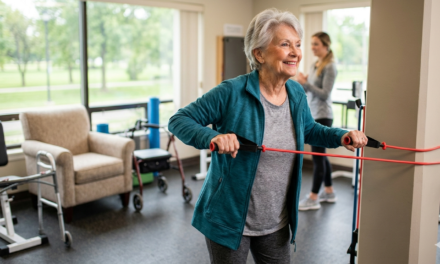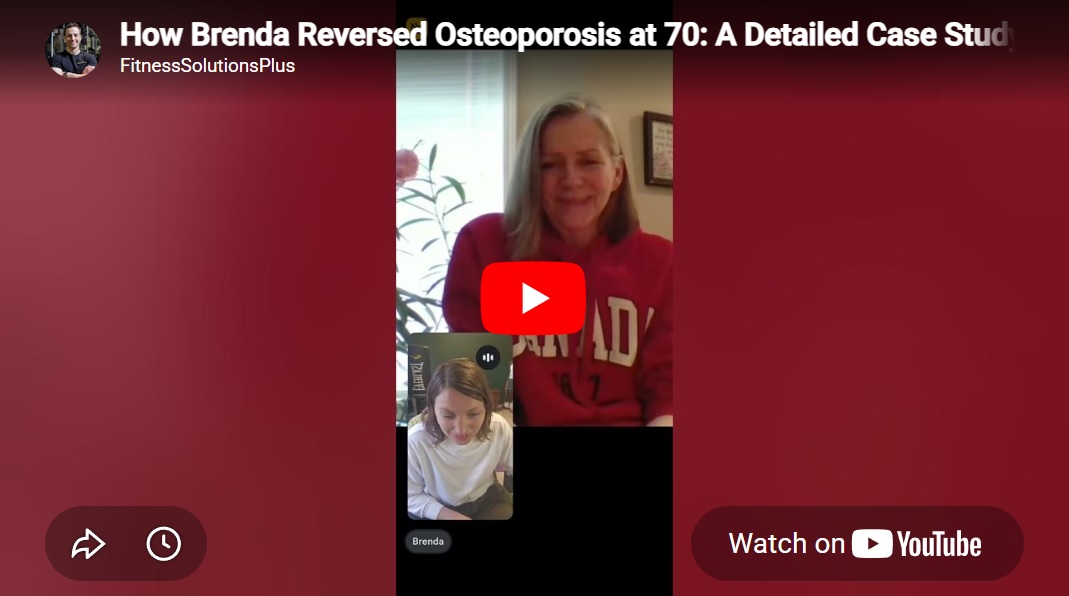
Meet Brenda. She’s a 70-year-old social worker, who was diagnosed with osteopenia in her 40s, progressed to osteoporosis, and then we turned that around. How did we do that? That’s exactly what we’ll cover in this article.
If you’d like Brenda to tell her own story, you can check out this 10-minute video:
In this article, we’ll cover:
- Brenda’s life beforehand
- What she’s tried to improve her osteopenia (and how it worked)
- The exercise program that improved her bone density
- The nutritional recommendations we made
- The results she achieved: how her T-scores (bone density) changed
- Obstacles along the way
- How her life is different now that she no longer has osteoporosis
And if you’d like to improve your own bone density, we have a special program called the “Osteoporosis Reversal Program.” If you’d like to see whether you qualify for that program, just fill out the application form on our home page. Doing so doesn’t obligate you to anything. It simply sets up a quick, 10-15-minute chat where we try to understand your situation, and see whether we can help you. There’s no obligation, pressure, or sales pitch.
Brenda’s Life Before
Brenda was always pretty active, yet despite that, she was diagnosed with osteopenia in her 40s.
Once she was diagnosed, she tried some things that conventional wisdom tells you to do, like yoga, calcium, and vitamin D supplements – things that I cover thoroughly in my first and second osteoporosis books about how and why they don’t work. In addition to that, she also tried walking and hiking. Those are fun, healthy, and generally good for you. Unfortunately, they don’t strengthen the bones either.
Despite all of this, her bone density continued to decline.
Eventually, she decided to hire a personal trainer (not one of my team members). And she worked hard with him, yet despite that, her bone density continued to decline. Bummer. That’s what I explain in one of my articles – not all personal trainers are created equal. About 99% of personal trainers don’t know anything about osteoporosis. Terms that seem basic to you (like T-Scores, DEXA scans, etc.) are completely foreign to most personal trainers.
After all these failed attempts, she finally went on medications (both oral and injectable), but she didn’t tolerate them well (she had gastrointestinal symptoms). She was especially concerned about the side effects, like a rotting jaw, and the subsequent loss of teeth, as well as spontaneous bone fractures. Even so, the best that medications did was they maintained her bone density. But Brenda didn’t want to maintain. She wanted to improve.
Eventually, she bought my first osteoporosis book, read it, subscribed to my newsletter, and after a couple of years, reached out to get some dedicated help for osteoporosis. Although it wasn’t quite that straightforward. She did have some hesitations, like:
- It’s certainly a financial commitment. Personal training ain’t cheap (although we do have options for people who can’t afford personal training).
- It’s most definitely a time commitment. Once you commit to personal training, it means you’re serious. By yourself, you can easily let yourself off the hook. A personal trainer won’t allow you to do that.
- Online training: can an online personal trainer really get results? Hint: as you’ll see later in this article, yes, they can (but not just every online personal trainer). As I mentioned earlier, it’s extremely rare to find a personal trainer who understands osteoporosis/osteopenia. So in-person gives you the convenience of well… going somewhere, but you’re sacrificing effectiveness. Online training, on the other hand, allows you to access trainers with expertise that local trainers may not have. On a more practical note, my team has been doing online personal training since about 2016-2017, and we haven’t seen a difference in effectiveness between online and in-person training.
Besides that, there were a few other things that appealed to her about online personal training:
- She felt a bit anxious about going to the gym.
- She was able to commit better because the commute time was eliminated.
Eventually, what made Brenda decide to hire one of my team members is a perfect storm of:
- Not tolerating the medications very well
- Breaking her leg 8 months before she started working with us
- Turning 70
- Not wanting to commute to the gym
At that point, she reached out to me, I set her up with her personal trainer, Ashley, and they got to work.
In addition to improving her bone density, Brenda also wanted to improve her posture (one consequence of osteoporosis/osteopenia is poor posture).
Brenda’s Exercise Program
Here are some of the highlights of the program that Ashley designed for Brenda:
Exercise Selection
A basic principle of physiology is called “Wolff’s Law.” It states that bones only get stronger at the very spot where muscles pull on them with enough force. That’s why general exercise, while maybe good in general, doesn’t strengthen bone specifically. It’s not targeted, and the force isn’t high enough. Because of that, exercise selection is extremely important (and by extension, knowledge of anatomy).
So here are some of the exercises that Ashley had Brenda doing:
- Deadlift to bent-over row: Brenda’s weakest area (lowest T-Score) was in her lumbar spine (lower back). With one exercise, Brenda is working 2 muscles that attach to the lumbar spine.
- Goblet squats: this one is particularly good for the T-scores of the femoral neck and total hip.
- X-band walks: of the 3 areas measured by most DEXA scans (lumbar spine, total hip and femoral neck), the femoral neck seems to be the least responsive. That’s because most people trying to do it themselves have no knowledge of anatomy, and which muscles attach to nearby structures. So lateral motions are necessary to help the femoral neck. This fits the bill.
- Dumbbell side bends: This one is targeting the T-scores of the lumbar spine, because it works both the obliques (sides of the abs), as well as the muscles running along the spine, called the “erector spinae.” Again, for bones to get stronger, you have to train the muscles that attach to those bones. General exercise (like walking, yoga, pilates, group fitness classes, etc.) isn’t good enough. Targeted exercise is what’s needed.
These are just some of the highlights of Brenda’s program. There were more exercises, and more programs.
Furthermore, if you just read about the exercises, you’d miss the “secret sauce” of the exercise program – the progression model, and the workout-by-workout adjustments that were made based on Brenda’s progress from the previous series of workouts, energy/fatigue levels, and more. After all, no exercise program should be a static program, where you’re doing the same exercises for the same weights, sets and reps every single time. An exercise program should be dynamic, intelligently, purposefully, and systematically changing the exercise variables to move the client forward… as opposed to haphazardly changing the program whenever you feel like it, without rhyme or reason… like a lot of personal trainers do.
Number of Reps
The number of repetitions you do and the amount of weight you use are inversely related. You can’t lift heavy weights for many reps. But the question is whether it’s just a matter of preference (lighter weights for many repetitions or heavier weights for fewer repetitions), or whether one is clearly superior to another. After all – both are difficult for different reasons, but is difficulty enough for effectiveness?
The research is very clear on this. In one study, researchers divided up participants (who were both men and women, 60-83 years old) into 3 groups:
Group 1: control group. They didn’t exercise
Group 2: low intensity strength training. They did 1 set of 13 reps at 50% of their maximum, 3 times per week, for 6 months.
Group 3: high intensity strength training (same exercises as group 2). They did 1 set of 8 reps at 80% of their maximum, 3 times per week for 6 months
At the end of 6 months, group 1 saw no changes. Group 2 improved their strength, but not their bone density. Group 3 improved their bone density by almost 2%. What does this tell us? That light strength training is not enough to strengthen bones.
One large meta-analysis, that reviewed a bunch of studies found that strength training, using 2-3 sets of 8-12 reps, with 70-90% of your maximum, done about 3 times per week increases bone density.
The famous LIFTMOR study went even heavier – 5 sets of 5 reps.
See, bones don’t care about our preferences. Bones just respond to stimuli. We might prefer yoga or hiking over strength training. But that’s not the stimulus that makes bones stronger. The stimuli for bones are quite simple:
- Heavy weights or high resistance (relative to your own abilities).
- Progressive (getting heavier/more difficult over time).
- Targeted: training the muscles that attach to the bones with the lowest T-scores (bone density).
Brenda’s Nutritional Recommendations
First of all, if you’ve been a subscriber of my newsletter for any length of time, you already know my stance on calcium: it doesn’t work. I’ve written (it’s the first myth of the first chapter in my osteoporosis book) and talked about that extensively. Here’s a very detailed 15-minute video with my stance on calcium (both dietary and supplemental).
So calcium for osteoporosis is overrated. But protein for osteoporosis is seriously underrated. I first wrote about the importance of protein for osteoporosis in my book, in August 2022. Finally, by October 2023 a mainstream government body, Osteoporosis Canada, acknowledged the importance of protein for osteoporosis.
As I’ve mentioned in my other articles, I’ve never met someone who had osteoporosis and was also getting adequate protein. Most people with osteoporosis are unintentionally on a low-protein diet. Brenda was no exception.
Ashley calculated Brenda’s protein requirements, and after a dietary intake, figured out what was her actual intake. As expected, it was far below her requirements.
So together, they figured out simple strategies to increase Brenda’s intake.
It’s good to have more than one way to improve bone density (exercise, nutrition, supplements).
Brenda’s Results
Theory is nice, but in practice, how did all these strategies affect the bottom line – Brenda’s T-scores (bone density)? Here’s how:
- Lumbar spine (before she started working with us to now): -2.7 à -2.4
- Total hip: stayed the same (-1.4)
- Femoral neck: -2.1 à -1.7
But the most important thing isn’t even bone density. Rather, it’s fracture risk. Bone density is one component of fracture risk, but not the only component. I talk about the 5 components of fracture risk in this 6-minute video.
So based on bone density alone, by how much did her fracture risk improve?
- At the lumbar spine, it decreased by about 19%.
- At the femoral neck, it decreased by about 24%.
But this is using bone density alone, without taking into account the other 4 components of fracture risk. We know that strength training has a disproportionate effect on fracture risk, compared to just improvements in bone density. For instance, one study found a reduction in fractures by 62.8% from strength training, even though bone density improved “only” by 1-4%. So realistically, Brenda’s fracture risk dropped by likely about 35-45%, because strength training addresses more fracture risk factors besides just bone density.
Besides the improvements in her bone density, she also mentioned that people are commenting on how much better her posture looks.
Brenda’s Obstacles
Brenda’s results are quite good, but they didn’t come without a lot of obstacles, which is encouraging. It’s nice to know that you can get things mostly right (not perfectly right), and still get meaningful results.
Here were some of the obstacles along the way:
- While perfect compliance is, well… perfect, that only represents a tiny percentage of people with osteoporosis. We wanted Brenda to strength train 3-4 times per week. But Brenda has ADHD, which makes planning and compliance really challenging. For the first 6 months, she was only strength training once per week.
- She also had a month-long vacation, during which time she didn’t exercise at all.
- She also had 2 smaller, 2-week vacations.
- She’s also had a recurring tennis elbow issue, which makes it hard to lift heavier weights. And yet, we still find workarounds.
- Brenda has a vestibular (balance) issue that prevents her from jumping (one of the most effective forms of exercise for osteoporosis).
- She also has scoliosis.
Yet, in spite of her obstacles, and maybe only 40-50% compliance, she got the results that she did. Quite impressive.
How Brenda’s Life is Different
Now that Brenda’s bones and muscles are a lot stronger, how is her life different? In a big way:
- She no longer has osteoporosis!
- Her self-confidence is much better
- She has more energy than before
- The exercise has carried over to other areas of her life, and she’s able to schedule her activities better.
If you want results like Brenda’s, we have a special program called the “Osteoporosis Reversal Program.” If you’d like to see whether you qualify for that program, just fill out the application form on our home page Doing so doesn’t obligate you to anything. It simply sets up a quick, 10-15-minute chat where we try to understand your situation, and see whether we can help you. There’s no obligation, pressure, or sales pitch.