Meet Ette. She’s a 65-year-old retired teacher with one young grandson. She was diagnosed with osteoporosis about 2 years ago. That came as a huge shock to her as she’s otherwise so healthy. She’s active, eats what she thinks is healthy, and yet, to her surprise, she had this unfortunate diagnosis.
The standard treatment of medications didn’t appeal to her, so she researched how to improve it without medications, and she stumbled on to my first osteoporosis book.
Fast forward to now, and her bones are significantly stronger than before. How did she do it? That’s exactly what we’ll cover in this article. If you’d like to hear Ette tell her own story, check out this 8-minute video:
And if you want some personalized help with your own or a loved one’s bone density, we have a special program called the “osteoporosis reversal program.” If you’d like to see whether that program is for you, just fill out the application form on our home page. Doing so doesn’t obligate you to anything. It simply sets up a quick, 10-15-minute chat where we’ll discuss your current situation, and see whether we can help you. There’s no obligation, sales pitch or pressure.
Ette’s Life Before
Her whole life, Ette has been very health-conscious. In high school and university, she was a sprinter, and even afterwards, she was active, took up long-distance running, taught fitness classes and generally ate healthy.
And for the most part, it worked – she didn’t have diabetes, high blood pressure, elevated cholesterol, obesity, etc.
So getting diagnosed with osteoporosis felt like it came out of nowhere. How could this happen to her? Spoiler alert: if you’ve consumed my osteoporosis content in the past, you know that the 2 biggest factors are strength training and adequate protein. She was active, but not strength training, and she was on a vegan diet (unless you’re a vegan who’s conscious of your protein intake, you get very low protein).
Besides the huge shock that came initially, she also felt sad.
She went to her doctor to figure out what to do. The doctor recommended medications. Ette looked up the side effects of the meds, and didn’t like them. And granted, not everyone experiences side effects, but the problem is that you don’t know whether you’ll have side effects until after you’ve started medications.
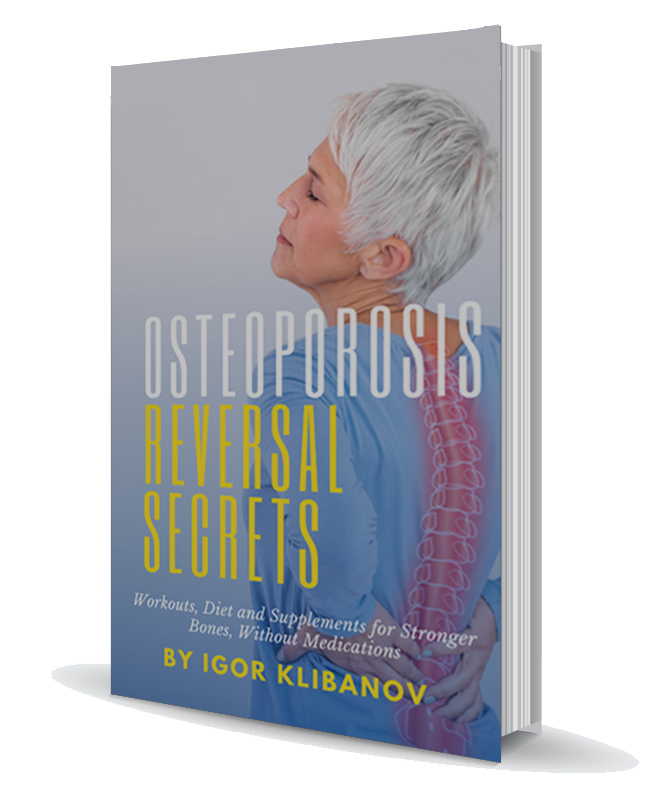
So she looked for non-pharmacological methods of reversing osteoporosis, and she came across my first osteoporosis book. The subtitle was exactly what she was looking for: “Workouts, Diet and Supplements for Stronger Bones, Without Medications.” She bought the book, liked what I had to say, and reached out.
Of course, personal training is not usually people’s first approach at resolving these issues. People often try other things, since personal training is both high-price and high-commitment.
But there are 3 main reasons that Ette decided to get personal training:
- As mentioned earlier, she didn’t want to go on medications.
- What she was already doing wasn’t working. Fitness classes and jogging are great for overall health, but they don’t help the bones specifically (and obviously, since Ette got osteoporosis in spite of her activity).
- She saw my long track record with osteoporosis clients, like Darlene, Laura, Ann and others. All of whom had real, measurable improvements. She didn’t just want to hire any personal trainer (as most of them don’t understand osteoporosis). She wanted to hire one that actually specialized in it, and has a track record of success.
So with that, she reached out to me, and we got started.
Ette’s Exercise Program
Here are the highlights of Ette’s exercise program:
Sets and Reps
One critical element of exercise prescription is the number of sets and repetitions. It’s often a question of should you do higher weights with lower reps or lower weights with higher reps? After all, if you lift a light weight enough times, your muscle will burn. Because of that difficulty, a lot of people think it’s strictly a matter of preference. But boy, are they wrong. This is one critical mistake that people make (including most personal trainers): they confuse difficulty with effectiveness.
Don’t get me wrong – hard work is necessary. But working hard on the wrong thing won’t get you the result that you want. If your goal is to run a marathon, and you only lift weights – it’s going to be difficult, but ineffective. You’re using the wrong stimulus. The opposite is true as well: if your goal is to lift a heavy weight, and you train for that by doing long-distance running, you’re still working hard. But that hard work won’t help you lift a heavy weight.
This is critical for osteoporosis. The weight needs to be heavy enough that you can only do 12 repetitions (max), but not 13. If you can do a 13th repetition, the weight is too light.
Exercise Selection
The 5 main exercises that Ette was doing were:
Reverse hypers
Lat pulldowns
Lateral bends
Squats
1-legged deadlifts
Why did I choose these 5 specifically? Because of her T-scores (bone density). She had the worst T-scores in her lumbar spine – so we used 3 exercises for the lumbar spine. But she had better T-scores in her total hip and femoral neck. So we used 2 exercises for those body parts.
Yes, there are lots of different exercises for different body parts. Are they all equally effective, or are certain exercises superior to others? There is a clear superiority to certain exercises over others. I explain the 6 different criteria for exercise selection in this 10-minute video:
Now don’t take these exercises blindly and apply them to you. These were specifically selected for Ette based on the results of her assessment. If you copy the same ones, for you, they might be effective as well. But they could also be ineffective, or downright harmful.
Workout Format
Ette’s program was done in a circuit format. What is a circuit format? It’s a way of organizing training. It means going from one exercise to the next, and the next, before coming back to the first exercise again.
There are several different ways of organizing training. The most common of which is something called “straight sets.” That is – you do an exercise. Then rest for 30 seconds to 2 minutes. Repeat that exercise. Rest again. Repeat the exercise for a third time. Rest a third time. Move on to the next exercise.
While there’s a time and place for straight sets, it makes less sense for someone with limited time. Why? For two main reasons:
- In a 1-hour workout, you spend just as much (if not more) time resting as you do actually doing the exercise.
- Fatigue accumulates from one set to the next, and performance really drops.
Circuits solve both of those problems. By choosing several exercises for unrelated muscle groups, while one muscle is working, a different muscle is resting.
This maximizes the amount of workout time actually working out and not resting in between sets.
When one muscle group works (like glutes), the others rest (like quads), so you recover better and don’t lose as much performance across sets. Very efficient. We like efficiency.
Balance Training
Ette didn’t just work on her strength – she also worked on her balance. Bone density is one component of fracture risk, but it’s not the only component. A major component of fracture risk is how likely you are to fall in the first place. If we improve your balance, you’re less likely to fall.
So every workout, Ette was doing deliberate balance training that I discuss in great detail in this video:
Heel Drops
One of the most beneficial exercises for osteoporosis is jumping. Unfortunately, it’s also one of the riskiest exercises. So how can we get the benefits of jumping, while minimizing the risks?
You start with something called “heel drops.” You rise up on your tippy toes, and then slam your heels into the ground.
To increase the safety of this, I had her doing heel drops on a soft surface at first (carpet).
Tempo
After a couple of months of regular strength training, I added in a minor element that makes a major difference to her results: tempo. I instructed her to lift the weight as quickly as possible. It doesn’t matter whether the weight actually moved fast or not (a heavy weight won’t move fast). But it’s the intention to move it fast that counts. Why did I have her lifting fast?
While tempo doesn’t matter for most fitness goals, it makes a big difference for osteoporosis.
In one study, postmenopausal women were divided into 2 groups:
Group 1: traditional strength training
Group 2: same as the group above, but they lifted the weights as fast as possible. Same exercises, same sets, same reps, same frequency.
Despite identical programs, group 2 had significantly better bone density after two years. Group 2 lost 0.3% of their bone density. Group 1 lost 2.4%.
The above was simply Ette’s first program. But as all good things, eventually, it came to an end. No program lasts forever. Eventually, the body adapts to it, and it’s no longer effective. Usually, most programs last 2-6 months before it’s time for a change. So after 3 months on this program, we got her on to the next program.
Ette’s Nutrition
Before Ette came to me, she was on a vegan diet. The most important nutrient for osteoporosis reversal is protein (if this is news to you, I spend a chunk of my first osteoporosis book explaining why it’s not calcium or vitamin D). I’ve never met anyone with osteoporosis who also gets adequate protein. This is true for both omnivores and vegans, but it’s even more exaggerated for vegans.
As with all of our osteoporosis clients, first, we calculated Ette’s protein requirements. Then we calculated how much she was actually getting. The gap between her requirements and her intake was about 70%. She was eating 70% less protein than she needed.
We went over simple ways to get adequate protein on a vegan diet, and to my delight, she stuck to it.
Ette’s Results
Methods are nice, but results are nicer. So what were Ette’s results? Here were the changes in her T-scores:
- Two months before she started working with me:
- Lumbar spine: -4.2
- Femoral neck: -2.9
- Total hip: -2.9
- After 10 months of working with me:
- Lumbar spine: -3.6
- Femoral neck: -2.7
- Total hip: -2.7
More important than her T-scores is her fracture risk. It went from very high to low-medium.
Besides her bone strength, there were also some major improvements in her muscle strength. Here are just a few examples:
- Her squats increased from 15 pounds, up to 35 pounds.
- Her 1-legged deadlifts increased from 20 pounds, up to 45 pounds.
- Her lat pulldowns went from 60 pounds, up to 80 pounds.
Ette’s Obstacles
As successful as Ette was at improving her bone density, there were still obstacles along the way. Fortunately, not many.
One obstacle is equipment availability. She was working out at home, so she had to use the limited equipment she had. But that wasn’t much of an obstacle. The biggest factors in osteoporosis reversal are consistency, exercise selection, and appropriate progression. Equipment is way down the priority list. In fact, probably about 60-70% of our osteoporosis clients exercise at home, with very limited equipment (sometimes just dumbbells and resistance bands).
Another obstacle is of course the vegan diet. But, as I talk about in my article on vegetarianism (where I also talk about veganism), you can still get adequate protein on a vegan diet – you just have more limited options, and you need better planning. But it can be done.
How Ette’s Life is Different
Now that Ette’s bones are stronger, and fracture risk significantly lower, her life is dramatically different.
For one thing, breaking a bone was a persistent thought on her mind. It weighed heavily on her, and it affected her movements and activities.
She had a little grandson, who she runs around with. When breaking a bone was a persistent thought, she’d hold back. Now she’s cautious, but no longer anxious. She can enjoy her time with her grandson more.
Because of that, she feels much more comfortable in her daily movements.
And as a major bonus, she’s considering going back to sprinting – in her 60s! Don’t you love that? Awesome retirement project.
Overall, we’re very proud of Ette, and what she’s been able to accomplish.
If you want some personalized help with your own or a loved one’s bone density, we have a special program called the “osteoporosis reversal program.” If you’d like to see whether that program is for you, just fill out the application form on our home page. Doing so doesn’t obligate you to anything. It simply sets up a quick, 10-15-minute chat where we’ll discuss your current situation, and see whether we can help you. There’s no obligation, sales pitch or pressure.