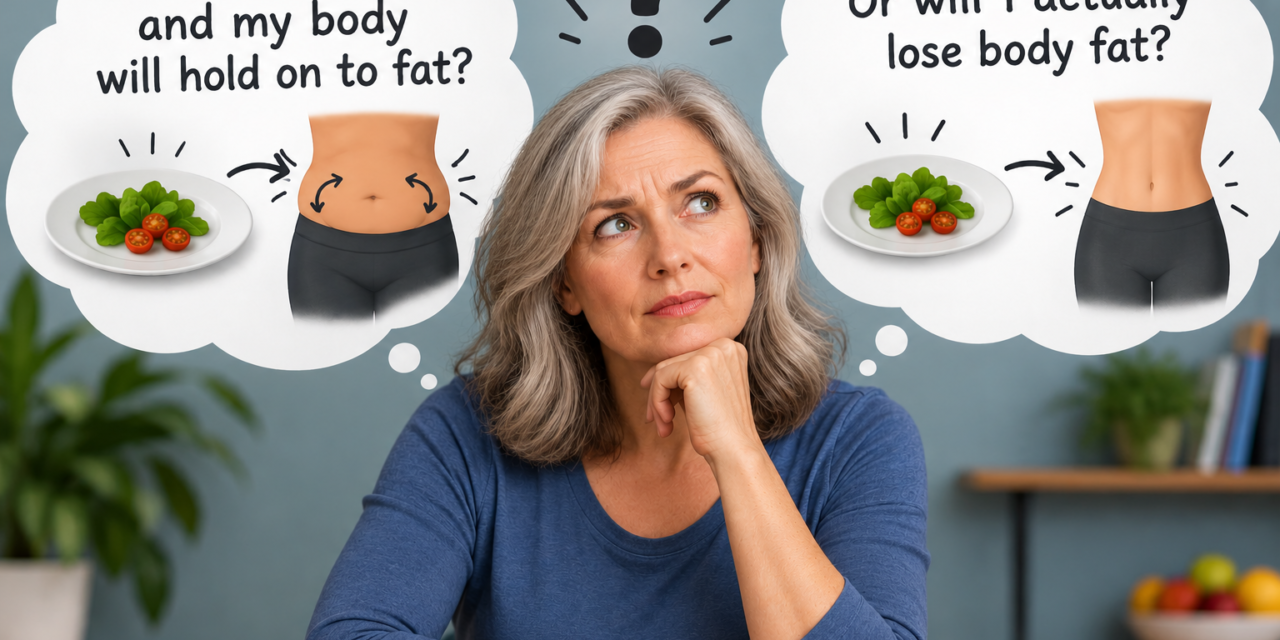
“I can’t lose body fat because I’m not eating enough” say lots of frustrated people, who are trying to lose body fat, but can’t. They believe they’re in starvation mode.
Just what exactly is “starvation mode”? Here’s how the theory goes: when you eat too few calories, your body thinks there’s a famine, so it holds on to the body fat. And this leads to a bit of a problem – overweight/obese people can’t eat more, because that’s how they got to be overweight/obese to begin with. And they think that they can’t eat less, because it’ll push them even deeper into starvation mode. So what do you do? And is “starvation mode” even real, or just something we tell ourselves to feel good, while being blissfully delusional?
Starvation Mode
Let’s look at both logic and research.
First, we need to bust a major myth: that overweight/obese people have a slow metabolism. That’s not true at all. Think about it this way: it takes more calories to sustain a larger body than a smaller one. So they actually have faster metabolisms than their normal-weight counterparts. It’s not that they have a slow metabolism. Rather, it’s that they have a big appetite. But it’s nice to blame metabolism – after all, that’s something that’s outside of your control, right? Blaming your appetite – that’s not so nice, because you’re in charge of what you eat.
“But I barely eat anything”, I often hear overweight/obese people say. First of all, our perception of how much we eat is terrible. In one study, 30 obese women were shown 10 common foods (cottage cheese, roast turkey, green beans, boiled ham, cooked spaghetti, coke, potato chips, blueberries, 1 slice of bread, 1 glass of orange juice). They were actually shown these foods – not pictures of these foods. They were then asked to estimate the calories of each individual item. On average, they were off by 53%. In other words, if they think they’re eating 1,800 calories per day, the reality is actually closer to 2,754.
Another very similar study found that people’s caloric estimates were 35% off. If they thought they were eating 2,000 calories per day, they were realistically eating 2,700 calories/day.
So what about the people who claim to be eating very little, and are unable to lose body fat? Do they have an extraordinarily slow metabolism, or incredibly good powers of self-deception (they aren’t aware of how much they were eating)?
A study was done to investigate that. It was done under very strict conditions. It’s called a “metabolic ward” study. What’s a metabolic ward? It’s a special hospital or research facility where everything a person eats, drinks and does is closely monitored by scientists. In other words, subjects in metabolic ward studies don’t live at home, where they have access to their own fridge, cupboards, and UberEATS.
This was a very well-designed study (am I the only one who gets excited about well-designed studies?). The researchers recruited 90 obese people. They then asked these obese folks how many calories per day they eat. Then, in the metabolic ward, they were given the exact number of calories that they claimed. They lost 4.9 lbs. per week.
This isn’t the only study of its kind. Other studies have been done to replicate these results.
So no, starvation mode does not exist. If someone is truly in a caloric deficit, they lose body fat. Want proof? Look at pictures of people who are actually in starvation – you see ribs, not bellies. If someone is not losing body fat, it’s because they’re not in a caloric deficit.