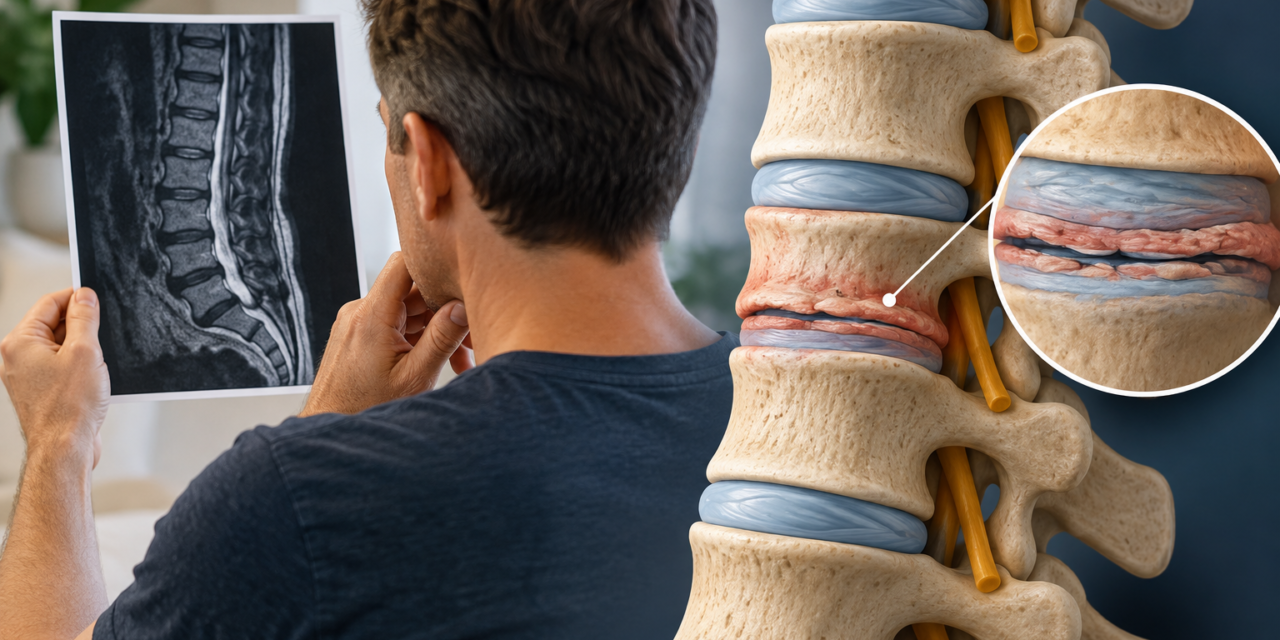
You’ve been having some pain in your back or neck, complained to your doctor about it, got sent for an MRI, and discovered that you have degenerative disc disease (we’ll call it “DDD” for the remainder of this article). You have mixed feelings about it. On the one hand, you feel relieved, because there’s a name for what you’re experiencing. And along with the name, presumably, there’s a treatment. On the other hand, you also feel anxious about it, because well… the diagnosis is degenerative disc disease. And the word “disease” doesn’t instill confidence.
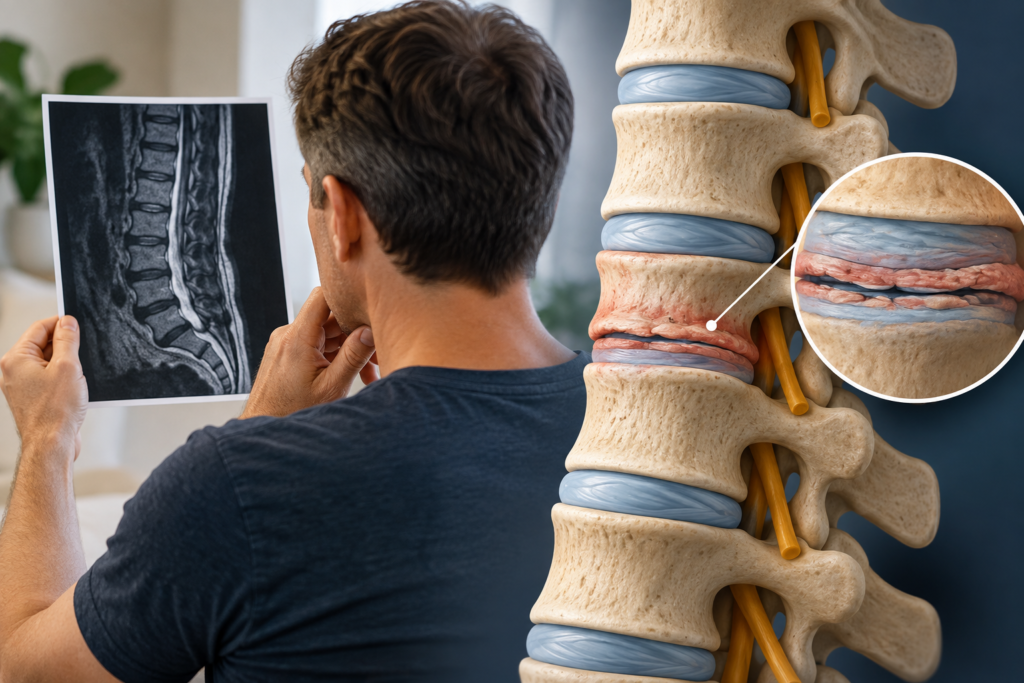
Degenerative Disc Disease
So what do you do? That’s exactly what we’ll cover in this article. You’ll learn:
- What is DDD?
- Common mistakes that the DDD patient makes when seeking relief.
- Common mistakes even rehab professionals make when treating DDD.
- Assessments that are helpful to understand the direction of treatment
Notice what we won’t cover? Specific exercises. Why? Because two people with DDD in the same place (neck, back) may need different exercises. Those exercises largely depend on the results of the assessments that we’ll talk about later in this article.
And if you want help with your own DDD, just fill out the application form on our home page. All that will do is set up a quick, 10-15-minute chat. During this chat, we’ll just talk about your situation, and whether we can help you (we have options for different commitment levels and budgets). There’s no pressure, obligation or sales pitch.
What is DDD?
Let’s break down the words:
- Degenerative: loss of normal structure.
- Disc: the cushion between vertebrae. It’s made of a gel-like substance.
The final, most menacing word of the diagnosis is “disease.” But that’s a giant misnomer, because DDD isn’t actually a disease. It’s simply a normal change that happens with age. It’s almost the equivalent of wrinkles that come with age. Only we don’t call wrinkles “degenerative skin disease.” Despite me not liking the term DDD, because it’s not an accurate description, since that’s what it’s called, I’ll use that term for the remainder of this article.
It’s literally a process of aging, because the vast majority of people have it. One study found that:
- 37% of 20-year-olds have DDD
- 52% of 30-year-olds have DDD
- 68% of 40-year-olds have DDD
- 80% of 50-year-olds have DDD
- 88% of 60-year-olds have DDD
- 93% of 70-year-olds have DDD
- 96% of 80-year-olds have DDD
So most people eventually develop DDD whether they have pain or not. That means finding DDD on an MRI doesn’t automatically mean you’ve found the cause of someone’s pain.
But of course, there is a minority of people that have both DDD and pain. What differentiates these two groups?
DDD on an MRI is mostly just noise if:
- It was discovered incidentally. There’s pain elsewhere in the body (not the spine). The spine was scanned in addition to the painful region, and it was just “discovered”. The word “discovered” was in quotation marks, because as you see, not having DDD is more rare than having DDD.
- The DDD doesn’t correspond well with the symptoms (we’ll talk about the symptoms shortly).
- The symptoms look like a different condition.
- The person has otherwise normal function… even if the MRI report has scary phrases like “severe degeneration”.
But DDD is more likely to matter if:
- There’s pain in the spine/neck.
- The spinal pain worsens predictably and consistently when you slouch.
- When pain that has spread away from your spine moves back toward your spine when you perform a particular movement.
- If you have nerve symptoms. For example, one of our clients experienced numbness along the outer forearm, pinky and ring finger. The nerve that “feeds” these (the ulnar nerve) originates at the neck/upper back.
So while MRI findings are useful, they’re not complete. There’s a saying in the rehab world: don’t treat the test. Treat the patient. Much more useful information would be what motions the person can and can’t do. This actually guides the treatment.
Common Mistakes That the DDD Patient Makes When Seeking Relief
Once a person is diagnosed with DDD, assuming they’re actually in pain, they start to look for ways to improve it, but along the way, they make some common mistakes (which is not their fault. After all, they’re not rehab professionals. They’re just being proactive):
Mistake #1: Not Moving
Assuming that the spine is damaged, and therefore, movement (exercise) will make it worse.
Mistake #2: Resting Too Much
If something hurts, a lot of people’s initial instinct is to rest – don’t move. First of all, we need to differentiate between complete rest and relative rest. Complete rest is a complete cessation of all exercise. That might not be so good. Relative rest means you’re just resting the body part that hurts, while continuing to exercise pain-free body parts.
Complete rest is rarely a good idea. It leads to full body deconditioning, and sends you into a downwards spiral, where you’re deconditioned (weak/frail), so you have less energy, so you don’t exercise. And because you don’t exercise, you become even weaker, and the cycle continues.
Relative rest is a good idea in the short term (until the symptoms subside) but then, it’s important to start training the formerly painful body part again, because if you don’t use it, you lose it (your strength, not your body part).
Mistake #3: Relying Exclusively on Passive Therapies
Passive therapies are things like massage, acupuncture, ultrasound, TENS, hot packs, etc. They’re good. They really help with symptomatic relief. And I frequently refer clients and readers to practitioners like massage therapists (especially James Alberto), physiotherapists and chiropractors (like Matt McGrath, David Song from Rehab Hero and the team at Step Up).
But despite being good, these therapies are also incomplete. As I outlined in my article on the 5 commandments of rapid rehab, you have to be an active participant in your own rehabilitation. That means exercise. If you have DDD with pain, it’s largely (but not exclusively) a strength issue – you don’t have the strength to move pain-free (again, there’s more to it than just strength, but strength is a major component). And you don’t build strength with massage, acupuncture or ultrasounds. You build strength with strength training.
Mistake #4: Not Progressing Strength Training
Even if a person strength trains (specifically for their pain), the common mistake is thinking that it’s the exercises themselves that are the primary driver of improvement. Exercises are important, but they’re only a piece of the puzzle.
As I talk about in my article, Exercise as Medicine, for a medication to work, it needs 2 things:
- To be the right medication.
- At the right dosage.
The right medication at the wrong dosage won’t work. The same is true for strength training. The right “medication” is choosing the right exercise. But the right “dosage” is:
- Load selection (how much weight you’re lifting or how much tension you’re using, if it’s a cable/resistance band. A load that’s too low won’t have the desired therapeutic effect)
- Number of sets
- Number of reps
- Weekly frequency
- Progression
Don’t forget the progression part, because you shouldn’t be doing an identical workout from one session to the next. You should be seeking to progress, especially increasing the weight/tension ever so slightly every 1-4 workouts.
Mistake #5: Thinking There is One Special “DDD Exercise”
Contrary to what many YouTube videos and social media posts will tell you, there’s no secret special exercise that will address all cases of DDD. An exercise that’s beneficial to one person with DDD may be harmful to another. Exercise selection depends on a number of factors, like:
- What a person actually can and can’t do (that requires testing)
- Symptoms
- Whether there’s nerve involvement or not
Mistake #6: Stretching Everything
If you’ve read my previous articles, you already know my views on stretching (short version: overrated. But don’t confuse the word “overrated” with “useless”. They’re not the same thing. There’s a use for stretching, but it’s really on a case-by-case, muscle-by-muscle basis, and usually, only in the short term. Unlike strength training and cardio that needs to be done basically forever, that’s not the case with stretching. But I digress).
Just because something feels tight doesn’t mean it actually is tight. As I’m fond of saying (about many things related to fitness): our feelings lie. So ignore them 😊 For actual tightness, rely on objective range of motion testing, as opposed to your feelings/sensations. Because frequently, the two don’t match. Lots of people feel tight despite already having optimal range of motion. In which case, more stretching doesn’t solve the tightness. If someone has deficient range of motion and feels tight, then stretching makes a lot more sense.
In some situations, stretching can even worsen symptoms. So don’t stretch indiscriminately. First figure out if you even need to stretch. If you do, stretch. If you don’t need to stretch, don’t. You’ll need the help of a professional to figure that one out.
Common Mistakes Even Rehab Professionals Make When Treating DDD
Within any category of regulated professionals (accountants, engineers, teachers, etc.), about 1% are so good they’re at the top of their field. About 10-20% are really good. The majority (70-80%) are somewhere in the middle – hovering between so-so, all right and good enough. Below that is bad, and below that, the bottom 1%, you wonder how they’re still in practice.
Again, that’s with regulated professionals. With unregulated professionals, it’s more heavily skewed towards bad.
So the mistakes I write about below don’t apply to every rehab professional. Obviously, the ones I mentioned earlier in this article don’t make these mistakes. These are more broad, but I’ve seen them enough to notice these patterns.
Mistake #1: Treating the MRI Instead of the Patient
Remember from earlier in this article – the MRI has to match the symptoms. If there’s an MRI showing disc degeneration, but the symptoms don’t present as such, the DDD may just be incidental, and not the cause of pain. Hence the need to actually speak to patients/clients to find out what are they experiencing.
Mistake #2: Not Being Mindful of Explanations
Sometimes, really smart rehab professionals have such a disconnect between what they know and what the patient knows, they use overly clinical explanations, like “your discs are worn out”, “bone-on-bone”, “your disc is compressed, and needs to be decompressed”, and others. All those explanations may be technically correct, but to someone who doesn’t understand those explanations, they can increase anxiety. And anxiety about pain can actually worsen the pain.
Mistake #3: Over-Reliance on Passive Therapies
This is one mistake that the patient and rehab professional both share: not using active therapies (ie exercise) as the central focus of the treatment. Rehab professionals get thorough training in things like soft tissue manipulation, joint manipulation, sometimes acupuncture and electrical stimulation. But they get relatively little training in therapeutic exercise (little side rant: eventually, therapeutic exercise should turn into strength training. That gap needs to be bridged. A person shouldn’t be doing “dinky little physio exercises” forever).
It’s too bad, because research repeatedly shows that proper exercise is often the most potent part of a treatment.
Although it’s a bit oversimplified, here’s the general rule: passive therapies are good for symptom management. Active therapies (i.e. exercise) are for long-term pain reduction/relief, and regaining lost function. They need to be combined.
Mistake #4: Under-loading Strength Training
This is another mistake that rehab professionals and patients both share: inappropriate load selection. Remember, we need the right exercise “dosage” to make progress. A major component of dosage is load (if you’re lifting weights, that’s the weight lifted. If you’re using resistance bands, it’s the tension on the band).
A core principle of exercise programming is progressive overload. That means “gradually more difficult over time.” A rehabilitation exercise isn’t inherently therapeutic merely because it has been labelled a “rehab exercise.” It’s only truly therapeutic when you have:
- The right technique
- The right load
- The right number of sets and reps
- The right number of days per week (frequency)
It’s the unfortunate truth that a lot of rehab professionals don’t strength train themselves. They might do other forms of exercise (sports like golf, badminton, hiking, rock climbing, etc.), but not strength training specifically. Because of that, they don’t progress. In my experience, those that do engage in strength training personally are much better at exercise prescription than those that just do sports, but don’t strength train.
Mistake #5: Using Generic Protocols
Rehab pros often go to seminars, and at those seminars are taught protocols. For example, “do this series of exercises for this type of patient, but this different series of exercises for this type of patient.” Protocols are useful starting points, but they’re not necessarily the end point. They have to be given to a patient, the patient’s response to that protocol needs to be assessed (is the patient improving?), and the protocol needs to be modified based on that.
Mistake #6: Overemphasizing Core Stability
Firstly, there’s a lot to unpack when it comes to core stability. A lot of people use the words “core” and “abs” interchangeably. They’re not the same thing. The abs are only about one fifth of the core. There’s more to it. But I elaborate on that in my article on core strength myths.
The rationale goes “if your core is weak, it won’t support your spine.” There’s some truth to that. But to think that a weak core is responsible for 100% of cases of achy backs is not correct. There are plenty of people with achy backs who have a strong core. Getting their cores even stronger is not likely to reduce their back pain.
There are other components besides the core that need to be strengthened.
Mistake #7: Not Getting the Patient Back to Real Life
The patient’s goal isn’t just to be pain-free on the therapy table. Their goal is to be pain-free in their life off the therapy table. So it’s important to ask what motions in their daily life produce pain. Then, it’s the rehab pro’s job to figure out how to make those motions pain-free. Whether that’s climbing stairs, walking, getting out of the chair, carrying groceries, playing golf, getting down on the ground with grandchildren, etc.
Important Assessments
As I’m fond of saying “if you’re not assessing, you are guessing.” So what assessments are important, in order to understand how to treat DDD (because again – what works for one person’s DDD isn’t the same thing as what works for another person’s DDD)? Besides taking a good history, and talking to a person, here are some important assessments we use with our clients:
Assessment #1: Centralization Testing
Centralization is when pain that has spread away from the spine (for example, down the leg) moves back toward the spine in response to a particular movement or position. That’s an important clue that in this person, their DDD is meaningful, and not just an age-related change.
Assessment #2: Painful/Limited Movements
Actually seeing which motions from their daily life cause problems goes a long way towards devising an effective exercise program for this person. At the end of the day, effective exercise therapy can be summarized as “find a painful movement, and figure out a pain-free variation of that movement. Progress that variation until the original movement is pain-free.”
One example of this that I use with my arthritis clients is I find that their knee/s might hurt getting out of their chair. Chairs are 18 inches high. But if you raise the height of the chair, it’s often not painful. So a person might start doing squats off a 24-inch chair. Once that’s pain-free, they do squats of a 23-inch chair. Then work their way down. Eventually, after a few weeks/months, what used to be painful (getting off an 18-inch chair) may no longer be painful. That’ s the method that I used with Sandy for climbing stairs.
Assessment #3: Neurological Involvement
This one, we often do in combination with a rehab professional – testing how involved are the nerves in this patient’s issue. One nerve connects to multiple muscles. So it’s important to test if all the muscles supplied by one nerve are affected, or just a single muscle. But nerves don’t just send signals out. Some nerves also gather sensations from the periphery to bring back to the brain for interpretation.
So it’s also important to test different sensations (pressure, light touch, deep touch, vibration, heat, cold, etc.) in the areas supplied by the nerve/nerves involved.
Assessment #4: MRI/Imaging
Last but not least, an MRI or other imaging can be a useful piece of the puzzle, but as mentioned repeatedly throughout this article, is not the whole puzzle itself.
Once we’ve gone through all these assessments (and possibly others), we have a much more direct, clear, and fast path towards speeding up our clients’ recovery from the pain, so rather than continuing to struggle, they get better, and get back to the activities they want to do, pain-free. If you’d like to have these assessments done on you, just fill out the application form on our home page, to see if you qualify. All that will do is set up a quick, 10-15-minute chat. During this chat, we’ll just talk about your situation, and whether we can help you (we have options for different commitment levels and budgets). There’s no pressure, obligation or sales pitch.