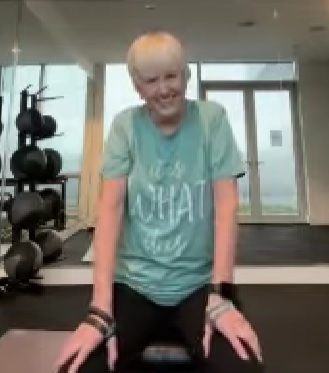
Meet Christena (we’ll call her “Chris” for short). She’s a 76-year-old retired doctor in Nova Scotia, mother of 2 adult daughters, and 2 adult grandsons.
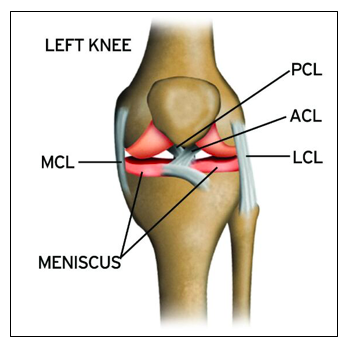
Although she’s had patellofemoral syndrome her entire life, about 6.5 years ago, she tore her MCL (medial collateral ligament – one of the knee ligaments). Since then, it was a serious bother – it affected her ability to climb stairs, and even woke her up throughout the night quite frequently.
Fast forward a few months, and nowadays, she climbs 7 flights of stairs, pain-free, and sleeps fine.
How did she do it? That’s what we’ll cover in this article. If you want to hear everything in her own words, you can check out this 9-minute video:
And if you want help with your own knee pain, just respond to this email with the subject line “pain-free knees.” Doing so doesn’t obligate you to anything. It will only set up a quick, 10-15-minute chat so that I can understand your current situation, and see whether we can help you. There’s no pressure or sales pitch.
Chris’s Life Before
Chris was always active, and she wasn’t overweight. She was already going to the gym a few times per week, just to stay active.
Like I said earlier, about 6.5 years ago, she tore her MCL, which drastically affected her life, but she kept going to the gym. Only her time there wasn’t really productive. In other words, she was active but not fit. During the summers, she walks 18 holes of golf, and gardens. But she certainly not the fitness level you’d expect from someone going to the gym 3-4 times per week.
About 5.5 years after tearing her MCL, she saw that she was still missing a lot of strength, range of motion and balance. Plus, the fact that she couldn’t climb stairs pain-free, or sleep through the night because of the knee pain was telling her that she’d plateaud.
But she didn’t know exactly what to do to improve her knee pain.
Fortunately, at this point, she’s been getting my newsletter for a while, saw that we have a great track record with knee injuries/knee pain (like Stellis, who eliminated her knee pain in 8 workouts, at age 83, Carol, who cancelled her knee replacement surgery, Warren, who eliminated his IT band pain in 2 weeks, and others), and decided to reach out.
Her big motivation was to restore the strength and mobility to be able to get out of her kayak without faceplanting.
So I matched her up with her personal trainer, Emmanuel, and they got started. But not without some hesitation at the beginning. She did have a couple of hesitations:
- Financial: Personal training ain’t cheap (although we do have some lower-priced, lower-commitment options).
- Safety: If she were to worsen her injury or get a new injury, it doesn’t just affect her. Her family depends on her. Fortunately, we prioritize safety. That’s the whole appeal of personal training – it’s personal. We don’t have a set program, where the client has to fit the program. Rather, the program fits the client.
Fortunately, the fact that her training was online wasn’t at all an impediment to her. She’s quite tech-savvy (although the amount of tech you need to know to make online training work is simply how to push 1-2 buttons, and that’s it), and the reason that online training appealed to her is expertise. She wasn’t limited by the very limited expertise of personal trainers in her close geographical area.
Personal trainers are a dime a dozen. I go to great lengths to only hire the best trainers I can find. I wrote a detailed article about my hiring process here. Very few trainers have great expertise in rehab. But Emmanuel does, as do all of my team members. That’s something that I both screen for in my interviewees, and train additionally once they’re hired. You just can’t find that kind of expertise in a personal trainer in any random gym.
A lot of clients prefer online personal training because they’re either too self-conscious to go to the gym, or they like that they can save travel time by exercising at home with the equipment that they already have (even if it’s very minimal, like dumbbells and resistance bands).
With those hesitations out of the way, Chris started working with Emmanuel.
Chris’s Exercise Program
Most people think very simplistically: “if there’s knee pain, you need to strengthen the quads (the muscles on the front of the thigh).” But remember from my article on knee pain – pain is a symptom, not a diagnosis. There are a million reasons why knees can hurt, like:
- MCL tear (in Chris’s case)
- ACL tear
- Meniscus tear
- Arthritis
- Patellofemoral syndrome
- Patellar tendinitis
…and that’s just scratching the surface. You know what’s the commonality between all of them? Pain. You know the difference between all of them? The treatment. Exercises that may be good for one kind of knee problem may be bad for another.
So Emmanuel had to be specific to MCL problems. Here are some of the exercises he selected:
- Side leg raises: to strengthen the muscles on the outside of the hip (gluteus medius). In MCL tears, the repercussions are not just at the knee – they also affects the joint above (the hip) and the joint below (the ankle). So we need to restore strength in neighbouring joints as well.
- Single-leg calf raises: speaking of the joints below, this one is to strengthen the connection between the knee and the ankle. That connection is the calf.
- Squats: to strengthen the quads (the muscles on the front of the thighs)
- Kneeling Sissy squats: to strengthen the quads when the hips are static.
- Deadlifts: to strengthen the hamstrings (the muscles on the back of the thigh) and glutes (butt muscles).
Chris has been with us for almost 9 months now, so this is just a snapshot of one of her programs. She’s had a couple of programs over her time with us so far.
Furthermore, if you just read about the exercises, you’d miss the “secret sauce” of the exercise program – the progression model, and the workout-by-workout adjustments that were made based on Chris’s progress from the previous series of workouts, energy/fatigue levels, and more. After all, no exercise program should be a static program, where you’re doing the same exercises for the same weights, sets and reps every single time. An exercise program should be dynamic, intelligently, purposefully, and systematically changing the exercise variables to move the client forward… as opposed to haphazardly changing the program whenever you feel like it, without rhyme or reason… like a lot of personal trainers do.
Chris’s Results
Theory is nice, but Chris came to us for results, not just good vibes. So how were the results? Quite good – as expected.
- When she first started, she was able to squat and deadlift 30 pounds. Now, she’s using 50 pounds for both exercises. Her thighs are much stronger.
- Floor press: went from 10 pounds, up to 30 pounds. Her upper body (chest, shoulders and triceps) is much stronger.
- Bent-over rows: went from 10 pounds, up to 50 pounds. Her biceps and mid-back are much stronger.
- Most impressively, she couldn’t jump before. Now she jumps 30 times per workout.
Most importantly, however, the very reason she came to us – pain – has been significantly reduced (in both magnitude and frequency). It went from about a 6.5/10, and something she felt every day, even at night, to now, only 2/10, and something she feels much less frequently.
How Chris’s Life is Different Now
Now that Chris has significantly less pain and more strength, how’s her life different? Well, nowadays, she climbs 7 flights of stairs, 1-2 times per day, pain-free. She still goes to the gym multiple times per week, except now, her workouts are actually productive. She also no longer wakes up at night because of her knee pain.
Additionally, Chris was a runner before tearing her ACL, and had to give that up. Until now. She can now run for 20 minutes on the treadmill (although it still causes knee swelling, but she can now do it. Before, she just couldn’t).
Overall, we’re very proud of Chris and how far she’s come. If you want help with your own knee pain, just respond to this email with the subject line “pain-free knees.” Doing so doesn’t obligate you to anything. It will only set up a quick, 10-15-minute chat so that I can understand your current situation, and see whether we can help you. There’s no pressure or sales pitch.