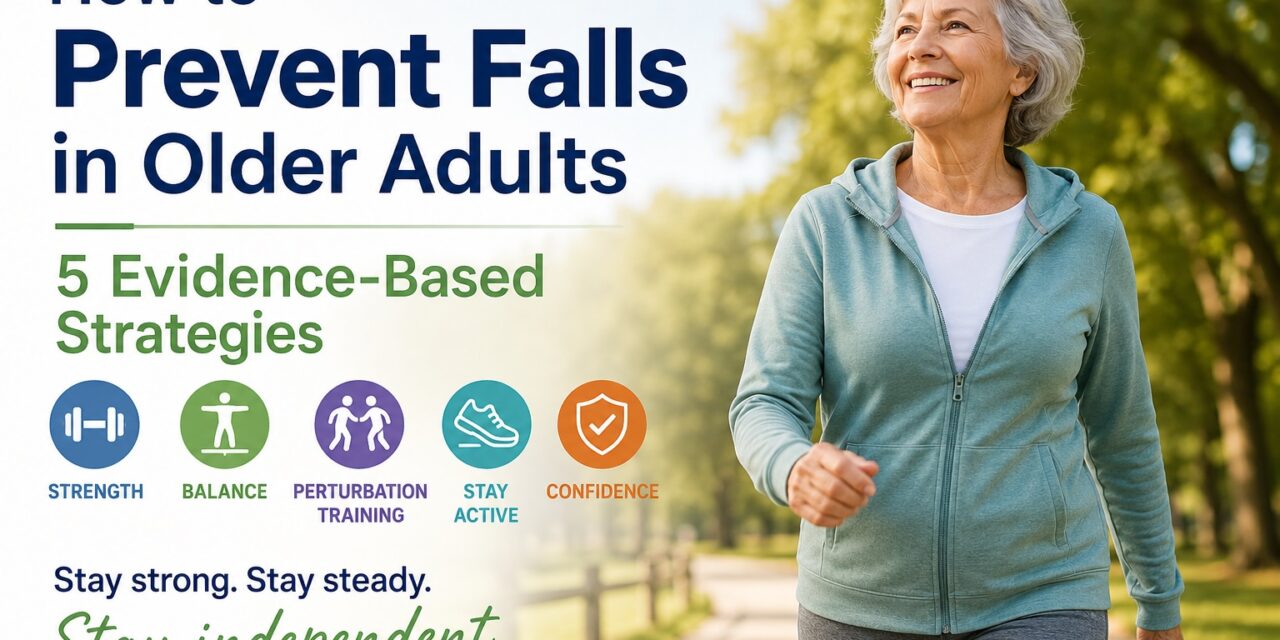
A lot of older adults have a fear of falling. They just imagine the consequences, like:
- The immediate pain of the fall
- A potential broken bone
- Hospitalization
- If they even make it out of the hospital, needing care either from family members, or professionals
- Because of their inability to get around, losing their independence
- And because of their inability to move, developing other conditions like diabetes, high blood pressure, osteoporosis (or worsening osteoporosis), etc.
…but it doesn’t have to be like that. This spiral can indeed be prevented or broken. That’s exactly what we’ll cover in this article.
But first, don’t…
Stop Moving
Because of the fear of falling, older adults logically think “if I don’t move, I can’t fall.” So they stop going out for walks, being social, or doing fitness classes.
But that’s a giant mistake. This turns their fear of falling into a self-fulfilling prophecy. Every step you take, every physical activity you do actually reduces your risk of falling. Why? Because every step you take is practicing how to not fall. Think about a baby: when they’re first learning to walk, they fall a lot. But they get back up, and keep trying. The more they try, the more successful they are at not falling.
So completely avoiding physical activity worsens balance and strength, and ironically, increases the risk of falling. Unless someone has completely committed to spending the rest of their life in a wheelchair, they’ll have to walk eventually (even short distances, like from the kitchen to the living room). And that’s when the fall they’ve been trying to avoid happens.
Even if someone uses a walker or cane, that’s better than not walking at all. I get that often, a walker/cane is used to walk because there’s pain. So there’s the downside of pain, but the upside of enhanced balance. How do you get the benefits (better balance), while minimizing the risk of pain? Here are a few ways:
- Walking shorter distances more frequently
- Switching from a cane to a walker (a walker can take more of your weight)
- Changing your gait, by turning your toes in or out to minimize the foot position that produces the most pain.
However, if the goal is fall prevention, and you’re not confident in your ability to maintain equilibrium, there are a number of very targeted measures that you can take, like:
Measure #1: Strength Training
I can’t think of many things more effective for overall health than strength training. It’s the one and only thing that can make a frail person not frail. Nothing else does that. There’s no diet, supplement, medication or form of exercise that does that.
A major part of fall prevention is simply having enough power in the lower body to get your legs under you once you start to fall.
Lots of older adults know that they are falling, but they simply don’t have enough lower body strength/power to get their legs under them to prevent the fall.
Never mind the many other benefits of strength training on overall health, like:
- It’s one of the most powerful interventions for poor cholesterol profiles, as I write in my book, High Cholesterol Reversal Secrets
- It’s highly effective for things like type 2 diabetes, high blood pressure, fatty liver, osteoarthritis.
- It strengthens bones, so that even if you do fall, all you get is a bruise, and not a broken bone.
Yes, general strength training helps. But it’s even better to do strength training that’s specifically targeted to fall prevention. If you want help with that, we have a comprehensive fall prevention program, that includes strength training (and other components). To see whether you qualify for that program, just fill out the application form on our home page. All that will do is simply set up a quick, 10-15-minute chat where we’ll discuss your situation, and whether or not we can help you. There’s no obligation, pressure or sales pitch.
Measure #2: Balance Training
Balance is the integration of information coming from your eyes, inner ears, and the skin of the sole of your foot. Those 3 “talk” to each other to maintain equilibrium. But all 3 are directly trainable. I’ve written extensively about balance training here and here, and have a video about it here.
Measure #3: Perturbation Training
Probably the gold standard in fall prevention is something called “perturbation training.”
This is training that is very specific to trips, falls and slips. Here’s a short video detailing what it looks like.
In most kinds of balance training, the goal is to prevent yourself from losing your balance. Whereas in perturbation training, you lose balance on purpose (a training partner pushes you off balance, without you knowing in which direction) in a safe, controlled environment, so you train the body to “catch itself” when balance is lost.
In one study, 35 people over 70 were divided into 2 groups:
- Group 1: perturbation training
- Group 2: tai chi
Both groups trained for 30 minutes, 3 times per week for 4 weeks. Across every measure, perturbation training was superior to tai chi:
- Amount of training: in this study, the tai chi group didn’t improve their balance at all. Why did balance improve in other studies but not in this one? A big reason is that the studies that show balance improvements from tai chi have people training 3-7 times per week for 50-60 minutes. Here, they trained 3 times per week for 30 minutes.
- Magnitude of results: in this study, falls were not directly measured, but other balance tests were given. However, one study showed a 50% reduction in falls from just a single session of perturbation training. To show you that I’m not cherry-picking my research, an entire meta-analysis found a 46% reduction in falls from perturbation training.
- Speed of results: the tai chi group didn’t see any results (for reasons we talked about earlier). In this study, the perturbation training group saw results in just a single week. In the other study I mentioned, they saw results (large ones) in just a single session.
- Durability: what happens after you stop training? Hopefully, you never stop, but if you do, how fast do the results go away? With tai chi, pretty fast. With perturbation training, they last and last and last. Like the energizer bunny. In this study, 6 months after perturbation training was stopped, their balance was still maintained.
I’m not aware of any other training method where after a single session or a single week you have such dramatic improvements in anything. To get a 50% improvement in strength from strength training requires 6-15 months. A 50% improvement in cardio almost never happens, because cardio can only improve by about 30%. But with balance training, both the magnitude and speed are very high.
Measure #4: Improve Sensation in the Soles of Your Feet
A lot of older adults lose sensation in their feet. It’s a condition called “peripheral neuropathy.” The most common reason for that is diabetes, but it can sometimes happen without it.
And there’s a simple solution: nowadays, they sell textured insoles that you put inside your shoes, wear for 30 minutes per day, and they bring sensation and sensitivity back to your feet, so you can both feel the ground better, as well as when you start to lose your balance.
Measure #5: Wearable Airbags
Another modern invention to prevent fractures in older adults are wearable airbags. You basically wear a belt. Inside that belt is a sensor that detects when someone starts to fall. Between the initiation of the fall, and the time you hit the ground, the bag inflates (like an airbag in a car), cushions your fall, and reduces 80-90% of the impact. It can literally be a lifesaver.
Common brands are Helite Hip’Safe, Tango Belt, or S-Airbag. I have no affiliation with any of these.
What Happens if You Fall
If you took the best possible preventive measures (you wore a belt, improved the sensation in your feet, did balance training), and strength trained properly for stronger bones, and have the mobility and strength to get off the floor (and if you don’t, that can be developed. I aim for all of my clients to gain that ability if they don’t already have it), all that happens when you fall is you simply get a bruise, get off the ground, and walk it off. The bruise goes away after a while.
For example, our osteoporosis client, Maryanne, had falls in 2019 and 2022 that resulted in bone breaks. Then, she started strength training. A couple of years later, her dog pulled her unexpectedly, and she fell again, only now, nothing happened. She just fell, got back up, and kept walking. Didn’t break anything.
So as you can see, a persistent worry about falling can be justified if you indeed have poor lower body strength, poor balance, and low bone density. But all these things are reversible (with proper exercise dosage, fairly quickly, too). And with improved lower body strength, balance and bone density, that fear of falling starts to go away. Especially when you have the confidence that a fall won’t lead to a downward spiral that results in a loss of independence and mobility.
If you want help with that, we have a comprehensive fall prevention program, that includes strength training, balance training and more. To see whether you qualify for that program, just fill out the application form on our home page All that will do is simply set up a quick, 10-15-minute chat where we’ll discuss your situation, and whether or not we can help you. There’s no obligation, pressure or sales pitch.