If you have osteoarthritis, chances are that glucosamine and chondroitin are two of the most common supplements that you’ve heard of. And for good reason – they’ve been around since the 1970s in Europe, and early 1990s in North America. But just because they’ve been around, does that mean they’re effective? That’s exactly what we’ll cover in this article. Unlike almost every other article on this topic, this one isn’t selling any supplements.

Original source: here.
So how do I make money? A couple of ways. I guess we should get acquainted.
Hiya! My name is Igor.
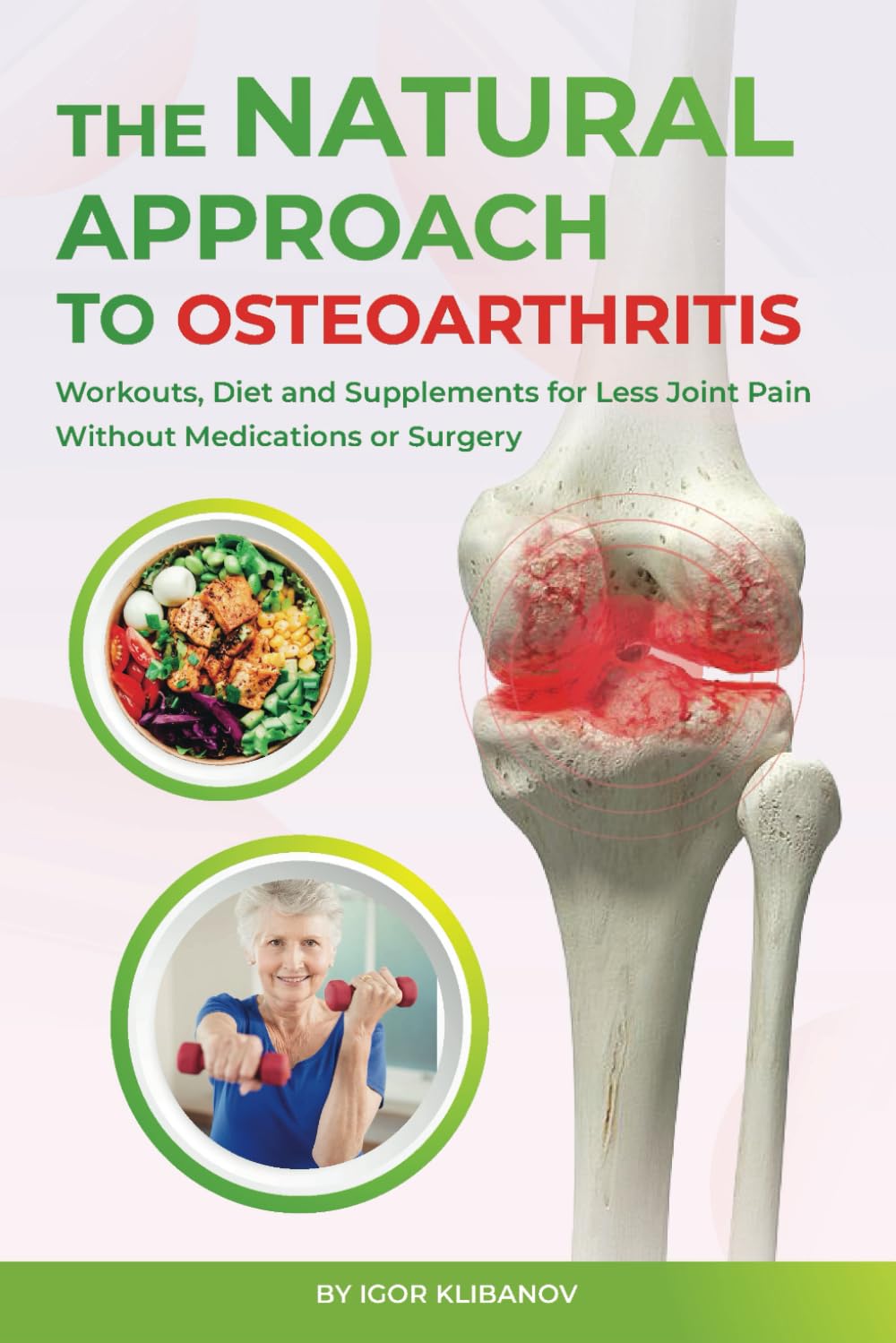
I’m the author of the Amazon bestselling book, The Natural Approach to Osteoarthritis. As well, I run an online personal training company that specializes in osteoarthritis. So those are the 2 ways in which I make money. I don’t make any money on supplements – which frees me up to be objective about what really works, and what doesn’t.
Here’s what you can expect to learn in this article:
- What are glucosamine and chondroitin?
- Effectiveness: how effective are glucosamine and chondroitin at managing osteoarthritis?
- Are glucosamine and chondroitin liquid supplements superior?
- Side effects
- Alternatives to glucosamine and chondroitin that really work
What are Glucosamine and Chondroitin?
Yes, they are supplements, but what exactly are they? Glucosamine is actually a sugar molecule (don’t worry, it’s safe for diabetics), found in the fluid around your joints. It helps build and maintain cartilage.
Chondroitin is another sugar molecule (for the geeks: glycosaminoglycan), also found in cartilage. It helps cartilage absorb water, which provides resistance to compression. So this helps your cartilage act as a shock absorber.
If they are both molecules that help with cartilage, it would seem logical that taking them as supplements would also help cartilage. But, as you’ll see soon, that’s actually not the case. We’ll explore the reasons for that in the next section.
How Effective Are Glucosamine and Chondroitin for Osteoarthritis?
Apparently, not very. And despite research that dates back to the early 2000s, not a single study has found that supplementation with glucosamine and/or chondroitin has made a meaningful difference to either cartilage, joint space, or pain levels.
One meta-analysis showed that glucosamine supplementation reduced only stiffness but not pain.
Another meta-analysis showed a very small difference between glucosamine and placebo. You might be thinking “a small difference – that’s better than nothing.” Not really. Pain is subjective. Nobody can verify that you’re in pain. A very small difference is only noticeable in a large population. When you ask a lot of people if their pain went down and a few of them say “yes.” On an individual basis, the effect won’t be noticeable.
Similar to glucosamine, research shows a very minor effect of chondroitin on the joint pain of osteoarthritis. It also slows down joint space narrowing.
I can hear you thinking “maybe by themselves, glucosamine and chondroitin aren’t effective, but are they more effective when taken together?” Nope.
In one study, 1,583 people were randomized into 1 of 5 groups:
- Group 1: glucosamine
- Group 2: chondroitin
- Group 3: glucosamine + chondroitin
- Group 4: celecoxib (a common medication)
- Group 5: placebo
After nearly 6 months, there weren’t any differences between any of the groups. Womp, womp.
So if glucosamine and/or chondroitin are conclusively ineffective at reducing joint pain, why are they recommended so often? Because they slow down cartilage degradation. Sometimes. And even then, slightly. They don’t relieve the pain you’re currently in. They just prevent that pain from getting worse in the future… but you’ll still be in pain. And if you have no cartilage left at all, preventing additional cartilage degradation is a moot point.
Do you find it weird that in the body, natural glucosamine and chondroitin help maintain cartilage, but as a supplement, they don’t? Why the discrepancy? There are a number of reasons:
- Just because glucosamine and chondroitin supplements go in your mouth doesn’t mean they end up in your joints. Between your mouth and your joints, there’s stomach acid. It destroys most of what’s in your supplements – regardless of whether it’s a capsule, or a glucosamine and chondroitin liquid supplement.
- The very little glucosamine and chondroitin that makes it past the stomach and may end up in your cartilage is not enough.
- Osteoarthritis starts off as wear and tear, but once it progresses, there are other factors that can accelerate cartilage breakdown, like inflammation, and specific enzymes that speed up the breakdown of cartilage. Glucosamine and chondroitin don’t help with those.
Are Glucosamine and Chondroitin Liquid Supplements Better?
Maybe traditional capsules are ineffective, but what about liquid supplements? Meh. There are benefits and drawbacks to both.
Liquid supplements are absorbed slightly faster. But I have 2 points to make:
- Their slight superiority in speed means nothing in terms of real-world results. Cartilage growth takes months or years. An absorption rate that’s a few minutes (or heck, even a few hours) faster won’t make a difference to pain levels.
- Also, notice the first sentence – they’re absorbed faster, not better. The total amount of glucosamine and chondroitin that gets absorbed is about the same.
A drawback of liquids is that the dose varies each time. The benefit of capsules is that you can virtually guarantee that a capsule contains the same amount as every other capsule in that bottle. Liquids vary slightly.
Liquid supplements also have more preservatives, sweeteners and flavorings, so that they taste good, and they have a good shelf life. Capsules don’t have preservatives, sweeteners or flavorings, but they do have fillers.
But arguing over whether glucosamine and chondroitin liquid supplements are better or not is a moot point, given the general lack of effectiveness of these supplements in any form.
Side Effects
Let’s say that you ignore all my advice, and despite that, decide to take these supplements, because your friend, a guru or some marketing master convinced you that they’re the best thing since sliced bread. Fine. You should at least know the possible side effects. They are:
- Upset stomach
- Heartburn
- Headache
- Drowsiness
Just because they’re possible doesn’t guarantee that they’ll happen to you.
Alternatives to Glucosamine and Chondroitin That Really Work
Now you know that glucosamine and chondroitin don’t work, but there’s still a problem: you still have joint pain. So what supplements do work? Two of the most effective supplements for osteoarthritis are type 2 collagen and fish oil.
One meta-analysis found a 40% reduction in joint pain in 90 days of using type 2 collagen. Pretty impressive, considering that it’s on par with exercise, and yet, you don’t have to exercise to get the pain reduction.
As for fish oil, another meta-analysis found an average pain reduction of 23% in 12 weeks. When you shop for fish oil/omega 3, the label breaks it down into EPA (eicosapentaenoic acid) and DHA (docosahexaenoic acid). Look for a product with a minimum of 500 mg of EPA.
These are the only 2 supplements that actually work for the pain of osteoarthritis. They don’t re-grow cartilage, but they do reduce joint pain.
Despite that, it doesn’t stop a lot of supplement companies from making claims about other ingredients, even though they’re unproven or worse, disproven.
If you need more help with your joint pain, there are 3 ways I can help you:
- Check out my playlist on YouTube about osteoarthritis here. Or check out this article that I wrote here.
- Buy my book on Amazon, The Natural Approach to Osteoarthritis.
- If you want the best option, apply for 1-on-1 online personal training by filling out the application form on our home page. Filling it out doesn’t obligate you to anything. It’ll just schedule a quick, 10–15-minute zoom call with us. On this call, there’s no pressure, no hardcore sales pitch, and no obligation. It’s just a simple conversation to understand your situation, and how we can help your joints.